Unity Home: A Display Font That Anchors Your Brand
Last week, I was finalizing the hero section for a new coaching website — clean layout, warm photography, intentional whitespace. The headline needed to feel grounded but inspiring, like a quiet promise rather than a loud claim. I opened my font library and landed on Unity Home. Not because it was trending, but because its name echoed what the client described as their core value: connection, stability, shared purpose. And visually? It delivered.
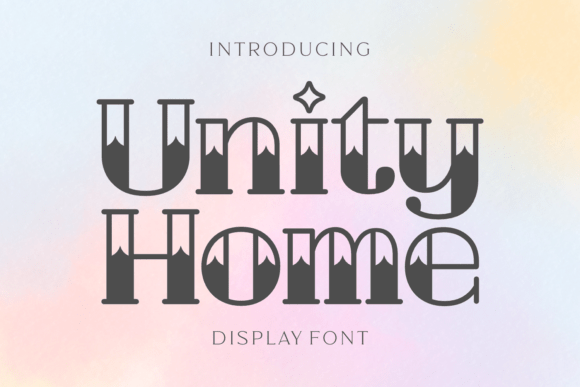
Unity Home is a display font with architectural confidence. Its letterforms balance structural solidity — strong verticals, consistent stroke contrast — with thoughtful negative space that breathes. But what makes it truly memorable is how it embeds subtle mountain peak silhouettes into the lower halves of characters like a, c, e, and s. It’s not literal illustration; it’s suggestion — a quiet nod to elevation, resilience, and natural harmony. That duality gives Unity Home a calm authority. It doesn’t shout. It settles in.
I tested it across real contexts: over a soft-focus landscape banner (it held up beautifully at 48px on desktop), inside a sticky header on scroll (still legible at 32px), and as a centered CTA button on a mobile preview (where I quickly scaled back to 24px and added generous padding). Unity Home works best where you want impact without aggression — hero titles, section headers, course module labels, shop category banners, and branded email headers. It’s not meant for body copy or long paragraphs, and that’s by design. As a display font, its strength lies in intentionality: one strong voice, placed with care.
On the coaching site, I used Unity Home only for the main headline (“Your Clarity Starts Here”) and the three core service pillars (“Rooted Coaching”, “Shared Growth”, “Sustained Change”). Everything else — body text, captions, navigation — is set in a neutral, highly legible sans serif. That contrast worked. Unity Home gave each pillar title weight and distinction, while the supporting type kept reading effortless. No cognitive load, no visual competition — just clear hierarchy.
Readability on mobile was surprisingly smooth, as long as spacing and sizing were adjusted thoughtfully. At smaller sizes, the mountain details soften naturally — they don’t distract, and they don’t vanish. What stays sharp is the rhythm of the letters: open apertures, generous x-height, and balanced proportions. On dark backgrounds, Unity Home gains even more presence — especially with light tracking and a touch of letter-spacing (I used letter-spacing: .05em at 36px and above). Over image overlays, I always check contrast first; Unity Home’s solid strokes pass WCAG AA at size 24px+ against mid-tone backgrounds, but I avoid it over busy or low-contrast imagery unless there’s a subtle text shadow or overlay.
Font pairing is where Unity Home shines brightest. It pairs effortlessly with humanist sans serifs like Inter, Poppins, or Manrope — fonts that share its warmth and clarity but stay out of its way. For a more editorial or premium feel, I’ve paired it with a restrained serif like Lora or Cormorant Garamond in headings, letting Unity Home handle the top-level emphasis while the serif adds texture in subheads or quotes. The key is restraint: Unity Home doesn’t need embellishment. It needs space, contrast, and consistency.
In practice, I’ve used Unity Home across several real projects: a boutique ceramics shop’s homepage banner (“Handmade. Grounded.”), a digital brand kit’s cover slide (paired with a crisp monospace for technical notes), and a course sales page where it anchored the headline and module titles — never the pricing table or bullet points. Each time, it reinforced tone without sacrificing usability. It didn’t make the site “prettier” in a superficial way. It made the message feel more intentional.
Before dropping Unity Home into any live project, I always verify a few practical things. First, webfont availability: does it come in WOFF2 format? (Yes — lightweight and widely supported.) Second, included styles: Unity Home offers Regular and Bold weights, which is enough for most display use cases — no need for Light or ExtraBold unless you’re doing heavy typographic layering. Third, licensing: it’s a commercial font, so I confirm usage rights cover web embedding, client projects, and SaaS platforms if applicable. No surprises later. Fourth, multilingual support: it covers Latin-based languages thoroughly, including accented characters for Spanish, French, German, and Portuguese — essential for any audience beyond English-only.
What surprised me most wasn’t how bold Unity Home looked, but how calming it felt. In a world of frantic gradients and kinetic animations, a font that feels like standing on solid ground is quietly powerful. It doesn’t chase attention — it earns it through presence. That’s rare in display fonts, which often lean into quirk or drama. Unity Home chooses stillness instead. And in digital experiences where trust and clarity matter — whether it’s a therapist’s landing page, a sustainable brand’s shop banner, or a designer’s portfolio headline — that stillness becomes a strategic advantage.
If you’re choosing a display font not just for aesthetics but for alignment — with your values, your audience’s expectations, and the emotional tone of your content — Unity Home invites you to slow down, settle in, and build something that lasts.