Texture Letters: A Display Font That Anchors Your Brand Voice
I was halfway through building a new landing page for a small-batch leather goods brand when I paused—cursor hovering over the hero headline, default sans serif looking just a little too neutral. The client’s voice was tactile, grounded, quietly confident. They didn’t sell mass-produced accessories; they sold heirloom-quality belts and journals stitched by hand in Colorado. That’s when I pulled up Texture Letters.
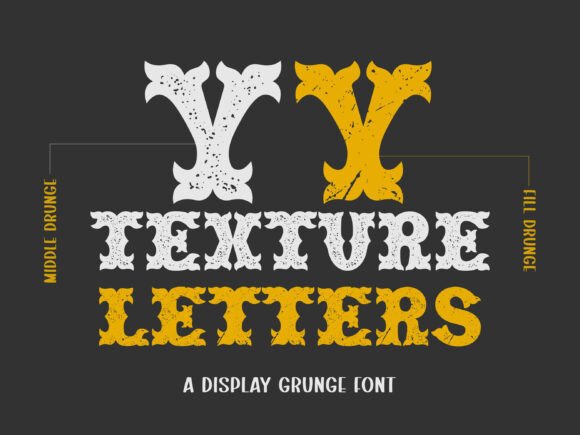
Right away, its personality clicked: massive slab-serif forms with weathered edges, subtle texture baked into each glyph, and that unmistakable frontier warmth—like ink pressed into aged kraft paper or carved into reclaimed barn wood. It’s not distressed for effect; it’s *worn* with intention. As a display font, Texture Letters doesn’t whisper—it declares. But crucially, it declares without shouting over the content.
In practice, I used it for the hero headline (“Built to Last”) and the subhead (“Handcrafted Leather Goods Since 2012”). No animation, no extra styling—just clean letter spacing, generous line height, and a warm charcoal gray on a soft cream background. On desktop, it felt substantial. On mobile? Still legible—but only because I kept it to a single-line headline at 48px (scaled down to 36px on smaller viewports) and avoided stacking multiple heavy words.
Here’s what I learned testing Texture Letters across real layout contexts:
- Hero sections & campaign banners: Perfect anchor point. Its weight holds attention without competing with imagery—especially over muted photo backgrounds or solid-color overlays.
- Section headings: Works best for top-level headers (H1, H2). I avoided using it for nested subheads—it’s too dominant for that role.
- CTA buttons: Tried it on a “Shop Now” button—looked bold but slightly cramped at small sizes. Switched to a clean sans serif there instead. Texture Letters shines in short, high-impact phrases—not functional UI labels.
- Logo text & branded graphics: Paired beautifully with a simple monogram icon. Its ornate structure adds craft without cluttering the mark.
- Blog headers & social media graphics: Used sparingly—once per post header, never inline. Great for drawing the eye to thematic titles like “The Art of Slow Making.”
Readability is where intention matters most. Texture Letters isn’t built for body copy—and it shouldn’t be. Its texture and contrast drop off sharply below ~24px, especially on lower-DPI screens or in low-light conditions. I tested it over a dark image banner and adjusted the background opacity and text stroke just enough to preserve clarity—no heavy outlines, just a whisper of contrast. On light backgrounds, it breathes easily. On dark, I added subtle letter-spacing (+0.5px) and made sure the font-weight wasn’t pushed beyond its natural heft.
Font pairing became intuitive once I stepped back from “matching styles” and focused on *role division*. I paired Texture Letters with Inter—a highly readable, open-source sans serif—for all body copy, navigation, and form labels. The contrast between rugged display and crisp utility created instant hierarchy. For a more editorial feel—say, on a founder’s newsletter page—I swapped in a warm, low-contrast serif like IBM Plex Serif for pull quotes, letting Texture Letters hold the spotlight only where it earned it.
Before deploying, I checked the technical details carefully: Texture Letters comes as WOFF2-ready webfonts, includes uppercase-only glyphs (which fits its display purpose perfectly), and offers one robust weight—no light or italic variants. That simplicity actually helped: fewer decisions, stronger consistency. No multilingual characters beyond basic Latin, so it’s ideal for English-first brands or those prioritizing visual tone over expansive language support. And yes—I verified the commercial license covers web use, client projects, and digital templates. No surprises at handoff.
Where it truly elevated the project wasn’t just aesthetics—it shifted how users *perceived* the brand. Early feedback from the client mentioned how “the typeface made our story feel tangible before reading a word.” That’s the quiet power of intentional typography: Texture Letters didn’t just label the product—it echoed its values. You can’t fake that kind of resonance with a generic font stack.
It’s also taught me to slow down before reaching for the next trending display font. Texture Letters works because it’s narrow in scope and deep in character. It doesn’t try to do everything—just one thing, exceptionally well: give weight, warmth, and authenticity to moments that need to land.
If you’re designing a boutique online store, coaching site with strong personal voice, portfolio highlighting craftsmanship, or a course landing page rooted in tradition and hands-on learning—Texture Letters isn’t just decorative. It’s a deliberate signal. A typographic handshake that says, “This matters. This is made with care.” And in a feed-saturated, scroll-heavy web, that kind of clarity is rare—and valuable.
Just remember: let it breathe. Use it where it has room to speak—then step back and let your content, color, and whitespace do the rest.