Children Story: A Playful Display Font for Editorial Warmth
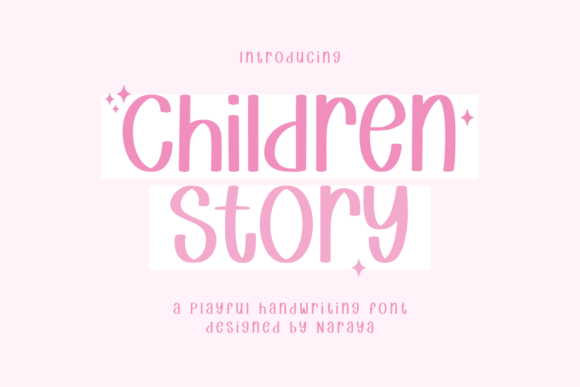
As a publisher and editorial designer who crafts digital magazines, illustrated ebooks, and branded newsletters, I’ve learned that typography isn’t just about legibility—it’s about tone, trust, and tactile resonance. Children Story stands out precisely because it carries emotional clarity: a playful yet intentional handwriting display font built not for whimsy alone, but for human-centered storytelling.
Its clean, bouncy lines—slightly rounded, gently irregular, and consistently warm—invite readers before a single word is read. Unlike many script fonts that sacrifice structure for flourish, Children Story maintains strong letterform recognition and rhythmic spacing. That makes it unusually versatile in editorial contexts where personality must coexist with professionalism.
Where Children Story Earns Its Place in Layouts
This display font thrives where attention needs gentle direction—not force. It’s ideal for magazine covers anchoring lifestyle or parenting features, ebook titles that aim to feel personal rather than polished, and newsletter headers that signal approachability without sacrificing authority. In a digital magazine about mindful parenting, for example, Children Story used for section headings like “First Steps” or “Quiet Moments” creates immediate tonal alignment with the content’s ethos.
It also excels in quote graphics and pull-outs. Because its rhythm feels hand-drawn but never chaotic, it supports emphasis without visual shouting. Try pairing it with a calm serif body font—like Merriweather or Lora—for long-form blog posts: the contrast invites the eye while preserving reading flow. For printable workbooks or coaching guides, Children Story works beautifully on chapter openers and worksheet headers, lending a handmade sincerity that resonates with readers seeking authenticity.
Designing With Intention, Not Just Decoration
What sets Children Story apart from decorative script fonts is its editorial discipline. It avoids excessive swashes or unpredictable connections—making it more reliable across screen sizes and PDF exports. On mobile, its generous x-height and open counters keep it legible even at smaller display sizes (though we recommend using it at 24pt or larger for headings). In print, it holds up well in both coated and uncoated stocks, especially when used for cover text or interior accents rather than extended body copy.
That said, Children Story is not intended for paragraphs. It’s a display font—designed for impact, hierarchy, and mood-setting. Use it for titles, subtitles, pull quotes, callout boxes, branding lockups, and lead-magnet covers. Let your body copy breathe in a highly readable serif or neutral sans serif (think Inter or Source Sans Pro for UI-friendly digital layouts). This pairing strategy reinforces visual hierarchy while honoring each typeface’s strengths.
Practical Pairings and Production Notes
For editorial projects, I typically pair Children Story with one of two approaches:
- A warm, low-contrast serif for body text—ideal for ebooks, long-form newsletters, and print magazines where texture and tradition matter;
- A friendly, geometric sans serif for captions, navigation menus, and sidebar notes—especially effective in digital-first publications or course materials where clarity trumps ornament.
The font includes standard OpenType features: ligatures for natural flow, stylistic alternates for subtle variation, and multilingual support covering Latin-based languages (including accented characters common in French, Spanish, and German). Before finalizing layouts, always test character rendering in your target export format—especially if embedding in EPUB or PDF files for distribution.
Consistency Across Content Ecosystems
When building a recognizable publication brand—whether it’s a seasonal recipe ebook series, a wedding planning newsletter, or a mental wellness workbook—the right display font becomes part of your voice. Children Story helps unify disparate assets: the same warmth appears on a printable planner cover, a social media graphic announcing a new guide, and the title slide of a workshop presentation. That consistency builds reader familiarity without requiring rigid repetition.
In practice, this means defining clear usage rules early: “Children Story is for all primary headlines, chapter titles, and branded quote graphics; everything else uses our core serif/sans system.” That discipline keeps the font feeling intentional—not decorative—and strengthens your publication identity over time.
Licensing for Real-World Publishing
If you’re releasing paid digital products—ebooks, Canva templates, printable planners, or client-branded newsletters—you’ll need a commercial license for Children Story. Most reputable font vendors offer tiered licensing: desktop use for internal design, web font hosting for blogs or membership sites, and extended licenses for redistribution in templates or digital downloads. Always verify coverage for your specific use case—especially if bundling fonts into editable design assets or selling branded content kits.
Importantly, Children Story is not a free font repackaged as premium. Its thoughtful spacing, balanced weight distribution, and editorial-ready alternates reflect deliberate craftsmanship—something that shows up in how smoothly your layouts come together and how warmly your audience responds.
Typography That Listens First
In an era where readers scroll faster and trust slower, fonts carry quiet influence. Children Story doesn’t try to dazzle—it offers presence. It signals care in the curve of a lowercase ‘a’, intention in the tilt of a capital ‘C’, and continuity in the way it harmonizes across formats. Whether you’re designing a quarterly digital zine, a downloadable habit tracker, or a gift-worthy children’s activity book, this display font meets your audience where they are: open to joy, responsive to warmth, and attentive to authenticity.
That’s why, after testing dozens of handwritten and script-style fonts for editorial use, Children Story remains my go-to for projects where tone matters as much as text.