More Sugar: A Playful Display Font for Handmade Charm
It was a quiet Tuesday morning—coffee steaming, scissors within reach—and I was finalizing the label design for my new lavender-vanilla soy candle. The scent was calming, but the typography? That was giving me pause. I’d tried three clean sans serifs and two elegant scripts, but none captured the warmth, sweetness, or handmade sincerity I wanted customers to feel before even lighting the wick. Then I opened More Sugar. Instantly, it clicked: thick, bouncy letterforms with soft edges and a gentle irregularity—like something drawn with a fine-tip marker on kraft paper. Not too cutesy, not too rigid—just right.
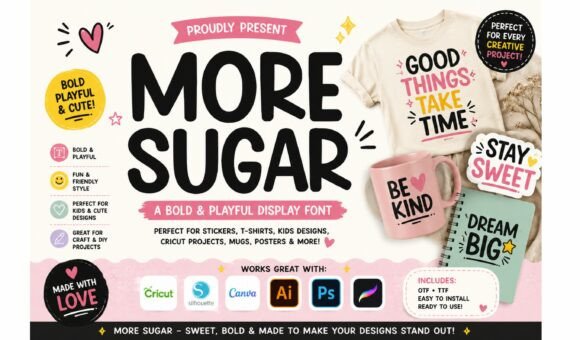
More Sugar is a display font built for personality. It’s not meant for body text or long paragraphs—it shines in short, impactful moments: product names, greeting card headlines, boutique tags, wedding welcome signs, or the “Happy Birthday!” on a printable party banner. Its handmade look comes through in subtle inconsistencies—the slight variation in stroke weight, the rounded terminals, the friendly openness of letters like ‘a’, ‘e’, and ‘o’. It feels warm, approachable, and intentionally imperfect—like your favorite small-batch bakery’s chalkboard sign, not a corporate ad campaign.
I first used More Sugar on a set of linen tea towel labels. Printed on matte sticker paper and applied by hand, the font held up beautifully—even at 14pt on a 2” x 1.5” tag. Because it’s a bold display font, it scales well: large enough to read from across a craft fair booth, yet detailed enough to feel crafted when viewed up close. For digital printables—like planner stickers or printable wall art—I’ve found it works best at 24pt and above. At smaller sizes (under 10pt), some of the charm gets lost, especially on low-resolution screens or printed thumbnails for Etsy listings. So I always preview mockups at actual size—not just zoomed in on my design canvas.
Real-world testing taught me where More Sugar truly sings. On candle jars? Perfect for front-label titles (“Honey Glow”, “Cinnamon Snuggle”) paired with a clean sans serif (like Montserrat or Inter) for ingredients and burn instructions. On greeting cards? Stunning as a single-word sentiment (“Joy”, “Hello”, “Celebrate”) stamped over watercolor backgrounds. For wedding stationery? Ideal for welcome boards, menu headers, or envelope liners—especially when paired with a delicate script for names and a grounded serif (like Merriweather) for details. And yes—it cuts cleanly on Cricut and Silhouette machines when converted to outlines and sized appropriately (I avoid using it below 0.25” height for intricate vinyl cuts).
What makes More Sugar especially useful for makers is its versatility across formats. I’ve used it in packaging design for seasonal bath bombs (paired with a minimalist sans for weight and scent info), on printable holiday gift tags (exported as high-res PNGs with transparent backgrounds), and even as part of a digital download bundle—where it appears in editable Canva templates and layered PSD files. Because it’s a commercial font, I double-checked the license before including it in those templates: yes, it permits use in both physical products and digital goods sold to end users, as long as the font file itself isn’t distributed.
When pairing More Sugar, I lean into contrast. Its playful energy balances beautifully with restrained typefaces—think a crisp geometric sans for supporting text, or a gentle serif for fine print. I avoid pairing it with other heavy display fonts or overly ornate scripts; that tends to compete rather than complement. One unexpected win? Using it alongside a simple handwritten font (not too shaky) for quotes on printable wall art—More Sugar takes the spotlight, while the secondary font adds quiet intimacy.
Before adding More Sugar to any project, I always check what’s included: standard OpenType features, stylistic alternates (like a swash ‘Q’ or looped ‘g’), and whether multilingual characters are supported. For an international shop, that matters—especially if you’re designing bilingual holiday tags or packaging for EU markets. I also verify file formats: OTF and TTF are must-haves for compatibility across design apps, cutting software, and print houses.
It’s shown up on so many things since that first candle label: a set of acrylic boutique gift tags, a series of planner page dividers (with soft pastel backgrounds), a farmhouse-style wooden sign for a friend’s baby shower (“Sweet Little One”), and even the title text on a batch of printable cupcake toppers. Each time, it brings a consistent thread of warmth and handmade authenticity—without feeling repetitive. That’s the power of a strong display font: it becomes part of your brand identity, not just decoration.
Of course, More Sugar isn’t magic—it won’t fix weak layout or muddy color choices. But when used thoughtfully—as a focal point, not filler—it elevates perceived quality. Customers notice the care in the details: the way the ‘S’ curves just so, how the spacing invites pause, how the whole word feels like a little hug in typographic form. In a crowded handmade marketplace, that kind of emotional resonance matters. It tells people your work is made with intention—not just output.
If you’re choosing fonts for your next round of labels, cards, or digital downloads, ask yourself: does this typeface reflect the feeling I want someone to have when they hold or see my product? With More Sugar, the answer is often yes—especially when sweetness, sincerity, and a touch of handmade joy are exactly what you’re aiming for.