Bokolono: A Bold Display Font That Makes Handmade Products Stand Out
It started with a candle label—just one small 2.5" x 3.5" rectangle of kraft paper, waiting for its voice. I’d sketched the scent name—"Hearth & Honey"—in pencil, then opened my font library, scrolling past the usual suspects: safe sans serifs, delicate scripts, overused vintage displays. Then I saw it: Bokolono. Tall. Tight. Unmistakable. I typed the words in preview mode and paused. That was it—the kind of quiet “aha” that happens when a font doesn’t just fit, but lifts your product into sharper focus.
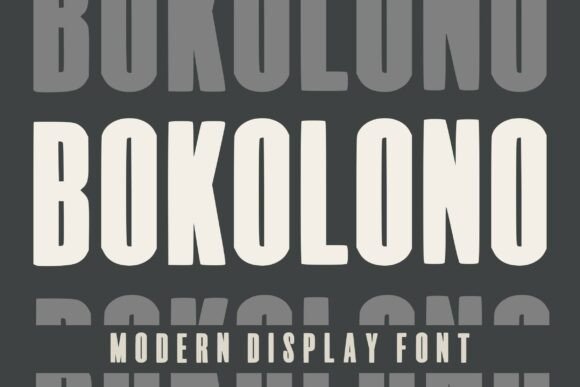
Bokolono is a modern display font built for impact. Its letterforms are tall and condensed, with clean lines, subtle geometric tension, and generous spacing between characters—so even at small sizes, it breathes. It’s not fussy or ornate, but it’s never flat. There’s a confident stillness to it, like a well-designed sign hanging on a sunlit boutique wall. It feels contemporary without chasing trends, bold without shouting, and intentional without being cold. As a maker who prints labels, cuts stickers, designs digital printables, and hand-presses packaging, I need typefaces that hold up across materials—and Bokolono delivers that consistency.
I’ve used Bokolono across so many real handmade projects: candle labels printed on matte sticker paper, wedding welcome boards laser-cut from birch plywood, printable planner cover pages shared as PDF downloads, seasonal gift tags tied to ceramic mugs, and even the front-of-pack text on small-batch soap boxes. It works especially well where you need immediate recognition—like on a shelf full of similar products, or in a crowded Etsy listing thumbnail. Because it’s a true display font, Bokolono shines brightest at larger sizes: headlines, titles, names, short phrases. Think “Wildflower Wedding,” “Summer Solstice,” “Small Batch • Hand Poured,” or “Est. 2022.” It’s not meant for body text or long paragraphs—and that’s part of its strength. It tells your audience, “This matters. Pay attention here.”
For physical products, readability is non-negotiable. With Bokolono, I’ve found success down to 14 pt on printed cardstock (for greeting cards and boutique tags) and 16–18 pt on die-cut vinyl stickers—even on curved surfaces like candle jars. When prepping files for Cricut or Silhouette, I always convert to outlines first, then check kerning manually, especially around tight pairs like “To” or “Fl.” The font includes clean OpenType features—standard ligatures and stylistic alternates—but no excessive swashes or flourishes, which keeps cutting clean and file prep simple. No surprises at the cutting mat.
Pairing Bokolono is intuitive. I often set it against a warm, neutral sans serif—think Montserrat Light or Inter Regular—for supporting text on labels or digital templates. For wedding stationery, I’ll layer it over a soft serif like Playfair Display or a restrained script like Quicksand for names and dates. The contrast works because Bokolono doesn’t compete—it anchors. It gives structure so the softer fonts can sing. And because it’s so visually self-assured, it even holds its own beside bolder display fonts in editorial-style wall art or shop signage—just keep hierarchy clear: Bokolono for the main title, something simpler for subheads and details.
What really sealed it for me was using Bokolono in packaging design. I designed a set of reusable cotton tote bags for a local herb shop—each with a single word in large format: “Thyme,” “Rosemary,” “Lavender.” Printed in deep charcoal ink on natural canvas, Bokolono gave each bag presence without pretension. Customers picked them up, turned them over, read the tagline in smaller type—and remembered the brand. That’s the quiet power of thoughtful typography: it supports your story instead of drowning it out.
Before using Bokolono commercially—whether on physical goods, SVG cut files, or digital printables—I double-checked the license. It includes full commercial use, multilingual support (Latin-based languages), and comes in OTF and WOFF formats—ideal for both desktop design and web-based shop previews. I also reviewed the included weights: Regular is the star, but having Light and Bold options added flexibility for layered mockups and social media graphics. No hidden limitations, no licensing fine print that made me pause before uploading a Canva template or listing a printable bundle.
It’s easy to overlook how much a font contributes to perceived quality—especially in handmade spaces where texture, color, and craftsmanship already carry weight. But Bokolono quietly elevates everything it touches. On a holiday ornament tag? It feels special. On a minimalist mug design? It reads as intentional. In a digital planner preview image? It signals premium design—not just another free download. That’s because good typography isn’t decoration; it’s part of your product’s voice, your shop’s rhythm, your customer’s first impression before they even touch the item.
If you’re choosing a display font for labels, cards, packaging, or digital assets, ask yourself: Does it reflect the care I put into every stitch, pour, press, or pixel? Does it scale across formats without losing clarity? Does it pair easily, license cleanly, and feel like *yours*—not just another trend? For me, Bokolono answered yes—to all three. It’s become my go-to for moments that need to be seen, remembered, and felt—not just read.
- Use Bokolono for candle labels, soap tags, and boutique packaging—its tall forms hold up beautifully on curved or textured surfaces
- Try it on greeting cards and wedding invitations where strong visual hierarchy helps guide the eye naturally
- Apply it to printable wall art, planner covers, and digital templates—its clean geometry translates crisply to screen and print
- Pair it with a friendly sans serif for body text, or a gentle script for names and accents
- Always test at actual size—on sticker paper, cardstock, and fabric mockups—before finalizing production files