Bromm: A Bold Display Font That Makes Handmade Goods Shine
There’s that moment—right after you’ve poured your third candle of the day, wiped wax from your counter, and opened your design software to finalize the label. You scroll through your font library, clicking past safe choices, until Bromm catches your eye. Not because it’s loud, but because it feels *intentional*: confident, artistic, quietly commanding. That’s when you know—this is the one for the “Honey & Sage” label. This is the voice your handmade goods have been waiting for.
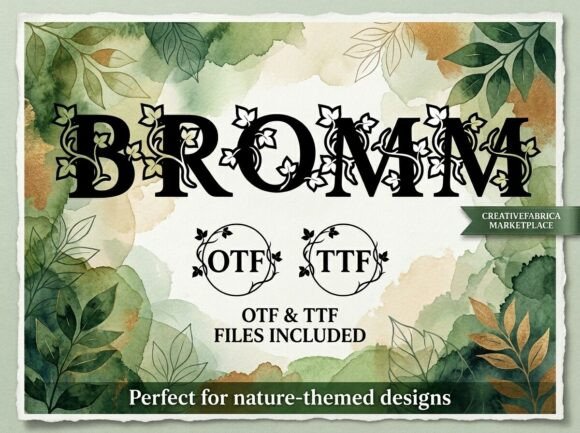
Bromm is a decorative display font built for impact—not background noise. It’s not meant for paragraphs or ingredient lists. It’s the kind of typeface that lands first in someone’s peripheral vision: strong strokes, subtle asymmetry, and just enough personality to feel human-made, not algorithm-generated. Think hand-painted signage meets modern editorial design—warm but precise, expressive but legible at a glance. Its charm lies in its balance: bold enough for a farmhouse welcome board, refined enough for a wedding invitation suite, and distinctive enough to stand out in a crowded Etsy thumbnail.
I reached for Bromm first when designing a set of seasonal printable wall art—four minimalist botanical prints for spring. Using it for titles like “Bloom Slowly” and “Tend With Care,” I noticed how effortlessly it elevated the whole composition. The font’s slight contrast and open letterforms gave breathing room, while its organic rhythm echoed the hand-drawn illustrations beside it. No extra effects needed. Just Bromm, sized right, and a clean sans serif (I used Montserrat Light) for subtitles—and suddenly, the print felt cohesive, intentional, and quietly premium.
For physical products, Bromm shines brightest where attention matters most: candle labels, boutique tags, greeting cards, and packaging accents. On a kraft paper sticker for a small-batch soap line, it held up beautifully—even at 12pt on a 1.5-inch tag. (Pro tip: always test cut at your final size in Silhouette Studio or Cricut Design Space—Bromm’s thicker terminals and subtle flourishes respond well to clean blade paths, especially with a fine-point blade.) On matte-finish greeting cards, it printed with rich, even ink coverage—no spindly gaps or fuzzy edges—thanks to its sturdy letter construction.
It’s also become my go-to for digital downloads: planner cover pages, printable quote cards, and wedding welcome sign templates. Because Bromm includes standard OpenType features—ligatures, stylistic alternates, and basic swashes—you can add quiet sophistication without switching fonts. A single “&” ligature on a couple’s monogram card, or an alternate uppercase “W” on a welcome board mockup, makes the difference between “designed” and “thoughtfully designed.”
That said, Bromm isn’t meant for long copy. It’s a display font—by definition, best suited for short phrases, names, titles, and decorative wording. Use it for “Est. 2023” on a tote bag hem tag, not the care instructions on the inside seam. For “Hand-Poured in Portland” on a mug, yes—but pair it with a simple sans serif (like Inter or Lato) for the scent description underneath. That pairing creates hierarchy, breathability, and visual trust: Bromm says *this is special*, while the supporting font says *this is clear and reliable*.
In wedding stationery, it adds warmth without cliché. I used it for the couple’s names on a rustic-chic invitation suite—paired with a delicate serif (Cormorant Garamond) for body text—and the contrast felt grounded and elegant. No script overload, no overused calligraphy. Just two voices working together: one bold and memorable, the other calm and readable.
Seasonal work is where Bromm truly flexes. For holiday gift tags, I scaled it down to 14pt on 2x3” kraft cards—it stayed crisp and charming, even with tight spacing. For a summer farmers’ market banner, I bumped it up large and let the letters breathe across burlap fabric. And for digital product previews? It performs beautifully in listing images: sharp at thumbnail size, expressive at full mockup scale—no pixelation, no awkward kerning surprises.
Before using Bromm commercially—whether on physical goods, SVG files for crafters, or editable Canva templates—always check what’s included: file formats (OTF, TTF, WOFF), language support (it covers Latin-based languages well), and licensing terms. Most reputable display fonts like Bromm offer commercial use, but confirm whether merchandise resale, template redistribution, or digital download bundling is covered. When in doubt, email the designer—their response tells you as much about their support as the font does about your brand.
What makes Bromm more than just another pretty face? Its consistency across applications. It reads clearly on a tiny sticker, commands space on a 24x36” printable, and retains character when scaled down for social media graphics. It doesn’t shout—it *anchors*. And in a handmade shop where every detail signals care, that kind of quiet confidence is everything.
So next time you’re choosing type for your next batch of labels, cards, or digital printables—pause before defaulting to the familiar. Try Bromm. Type out your shop name. Set a seasonal phrase. Drop it into a mockup beside your favorite neutral font. See how it changes the temperature of the whole design. Not louder—clearer. Not trendier—more *yours*.
Because great typography for makers isn’t about chasing what’s viral. It’s about finding the voice that feels true—and letting it speak, boldly and beautifully, for your work.