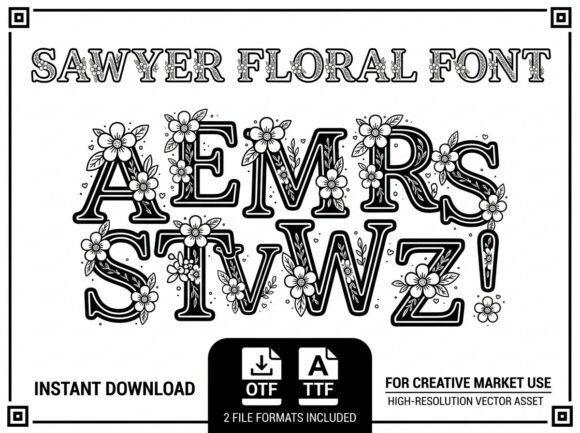
Sawyer Floral Typeface for Digital Branding
It started with a hero section—just me, a half-finished boutique coaching site, and that familiar moment when the headline feels flat no matter how many times I swap out the font. I’d tried three clean sans serifs, two elegant serifs, even a restrained script—but nothing gave the warmth and intentionality the brand deserved. Then I loaded Sawyer. Within seconds, the headline bloomed: “Your Calm, Curated Life” set in Sawyer over a soft linen texture. It wasn’t just legible—it felt like an invitation.
A Display Font That Breathes With Your Brand
Sawyer is a decorative display typeface rooted in natural elegance—think delicate floral motifs woven into strong, confident letterforms. It’s not fussy or fragile; it’s grounded. The capitals have gentle swashes and subtle botanical flourishes, while lowercase characters retain clarity and rhythm. As a web designer, I appreciate how its structure supports hierarchy: bold enough to command attention at 48px on desktop, yet graceful enough to scale down to 32px on tablet without losing charm. It’s a premium font built for moments—not paragraphs.
How Sawyer Performs in Real Web Layouts
I tested Sawyer across six key digital touchpoints:
- Hero headlines: Perfectly balanced weight and spacing—no awkward kerning traps or crowded ascenders/descenders, even over image overlays.
- Landing page section headers: Paired beautifully with Inter (a neutral, highly readable sans serif) for body text—Sawyer sets tone; Inter delivers clarity.
- CTA buttons: Works well at 20–24px on light backgrounds, but avoid using it below 18px or on dark gradients where fine details vanish.
- Blog post titles: Adds editorial sophistication without sacrificing scannability—especially effective in minimalist layouts with generous line height.
- Digital brand kits: Clients immediately responded to Sawyer’s warmth in mood boards and style guides—it communicates care and craftsmanship before a single word is read.
- Responsive behavior: Holds up cleanly down to 768px. On mobile, I use it only for primary headlines (not subheads or navigation), and always test contrast against background colors using browser dev tools.
Readability & Accessibility Considerations
Sawyer shines where impact matters most—but it’s not meant for everything. I never use it for navigation menus, form labels, paragraph text, or anything smaller than 20px. Its decorative elements reduce legibility at small sizes or low contrast, especially for users relying on screen readers or zoomed interfaces. For WCAG compliance, I keep all functional text in a tested, accessible sans serif (like Inter, Open Sans, or system fonts). Sawyer stays strictly in the display lane: hero text, section dividers, testimonial quotes, and branded graphics.
On image banners, I always apply a subtle text shadow or semi-opaque overlay to ensure Sawyer remains crisp against busy photography. And yes—I checked the included webfont files: WOFF2 is supported, and the package includes both regular and alternate glyphs (including stylistic sets for cleaner swash options), which helped me refine spacing in tight header layouts.
Smart Pairings for Modern Digital Experiences
The magic of Sawyer isn’t in isolation—it’s in contrast. I consistently pair it with:
- A clean, humanist sans serif (e.g., Inter, Poppins, or Manrope) for body copy, UI labels, and responsive navigation—this keeps content accessible and fast-loading.
- A restrained serif (like Lora or Cormorant Garamond) for blog headers or long-form editorial sections—adds quiet authority without competing.
- A single-line script (used sparingly!) for signature accents—like a handwritten “thank you” beneath a CTA—but never as a primary pairing.
This kind of intentional font pairing strengthens brand identity across devices and builds visual trust. Users don’t notice the typography—but they *feel* its consistency.
What to Check Before You Launch
Before deploying Sawyer on a live client site or your own shop, verify:
- Licensing: Confirm commercial web use is covered—especially if embedding via @font-face or using on client-hosted sites.
- Webfont formats: Look for WOFF2 (smallest file size) and fallback options. Avoid loading full desktop OTF/TTF files in-browser.
- Character support: Sawyer includes Latin-1 and basic diacritics—fine for English, Spanish, French, and German sites, but double-check if your audience needs extended language coverage.
- Weight options: It’s a single-weight display font—so plan hierarchy through size, color, and spacing, not bold/regular variants.
- Load strategy: Preload the font or use
font-display: swapto avoid invisible text during render—critical for perceived performance.
In practice, Sawyer hasn’t just upgraded my designs—it’s shifted how I think about digital tone. A font this expressive doesn’t shout; it leans in. It tells users, “This space was made with thought.” And in a world of generic templates and algorithm-driven layouts, that quiet intentionality? That’s what makes a brand feel human.