Jacan: A Bold Display Font That Elevates Digital Branding
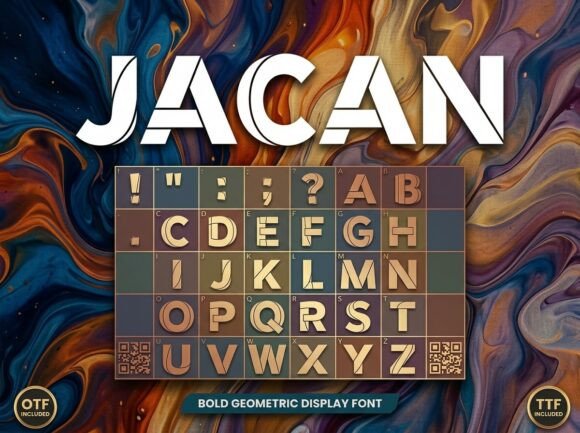
It started with a simple hero section refresh for a client’s creative coaching website. The existing headline felt safe—clean, legible, but forgettable. I opened my font library, scrolled past the usual suspects, and paused on Jacan. Not because it was trending, but because it had presence—like a well-placed accent wall in an otherwise minimalist room. I dropped it into the H1 tag, set the size to 3.5rem on desktop, and stepped back. Instantly, the page exhaled. Jacan isn’t subtle. It’s a decorative display font built for impact: high-contrast letterforms, expressive terminals, subtle asymmetry in its curves, and just enough artistic flair to feel intentional—not gimmicky.
In practice, Jacan shines where attention is scarce and intention matters most. Think of the first three seconds a visitor spends on your course sales page—the headline above the fold, the bold CTA button, or the short tagline overlaying a muted background video. That’s Jacan’s sweet spot. It’s not meant for paragraphs or navigation menus. It’s the visual equivalent of leaning in during a conversation: confident, curated, and human-centered. On a boutique online store’s homepage banner, it turned “Handcrafted Ceramics” from descriptive text into a tactile promise. On a portfolio site’s project title cards, it added rhythm without competing with imagery.
But here’s what I tested—and learned—during implementation: Jacan works best when given breathing room. At smaller sizes (under 28px), its details soften, especially on lower-DPI screens. On mobile, I capped usage at 2.25rem for headlines and avoided using it in buttons smaller than 44px tall. For touch targets, I paired Jacan with ample padding and generous line-height in the surrounding UI. When placed over image banners, I added a subtle semi-transparent overlay or used a soft text shadow to ensure contrast met WCAG AA standards—even on vibrant or busy backgrounds.
Readability isn’t about universal legibility with Jacan—it’s about contextual clarity. It reads beautifully at scale, in short bursts, and with strong typographic hierarchy. I used it exclusively for primary headings (H1, H2), section dividers, and branded graphic elements like newsletter headers or social media cover text. Never for body copy, form labels, or micro-interactions. Its personality is too rich for those roles—and trying to force it there diluted both the font’s strength and the page’s usability.
Pairing Jacan thoughtfully made all the difference. I consistently reached for a neutral, highly legible sans serif—think Inter, Manrope, or even system fonts like -apple-system—for everything else. Body text, captions, navigation, footer links—all clean, functional, and fast-loading. That contrast didn’t feel jarring; it felt intentional. In one blog redesign, Jacan handled post titles while a gentle serif (Cormorant Garamond) supported long-form articles—adding editorial warmth without sacrificing scannability. The key wasn’t harmony in style, but balance in function: Jacan commands, the supporting type serves.
Before deploying, I checked what was actually included. Jacan comes as a web-optimized font family—WOFF2 files for modern browsers, with fallback options for legacy support. It includes stylistic alternates (great for avoiding repeated characters in headlines), basic Latin multilingual support (covers English, Spanish, French, German, Portuguese), and a single robust weight—ideal for display use where consistency trumps variety. No light or bold variants, which honestly felt like a design win: it kept decisions simple and reinforced its role as a focused, premium font—not a Swiss Army knife.
Licensing was straightforward: a commercial license covers websites, SaaS dashboards, digital templates, and client projects. No hidden tiers for e-commerce or email campaigns. I verified that upfront—not just for legal safety, but because it shaped how freely I could integrate Jacan across assets. For example, using the same font in a client’s Notion brand kit, their Figma design system, and their live landing page felt cohesive, not fragmented.
What surprised me most was how Jacan influenced perception—not just aesthetics. On a campaign landing page for a mindfulness workshop series, early feedback noted the headline felt “more grounded,” “less generic.” That’s Jacan’s quiet superpower: it adds tonal specificity. A script font might say “handmade”; a geometric sans might say “efficient.” Jacan says “thoughtfully crafted”—a nuance that resonates with audiences seeking authenticity over polish.
Of course, it’s not for every brand. A fintech dashboard or a medical information portal would rightly skip it. But for creative entrepreneurs, boutique brands, educators launching courses, designers building portfolios, or small studios defining their digital voice—Jacan offers something rare: distinction without distraction. It doesn’t shout. It stands.
One final note on performance: because it’s a single-weight display font with modest character coverage, Jacan loads quickly—under 40KB total. I served it via a self-hosted CDN with preload on critical pages, and saw no layout shift in real-world testing across mid-tier Android devices and older iOS versions. No font-display: swap needed—just clean, confident rendering.
If you’re weighing whether a decorative display font belongs in your next project, ask yourself: where does your brand need to be seen, not just read? Where does a headline carry emotional weight as much as information? That’s where Jacan lives—not as decoration, but as deliberate, human-centered typography.