Sawira: A Bold, Warm Display Font That Earns Its Space
First Glance: Confident, Crafted, Unmistakably Human
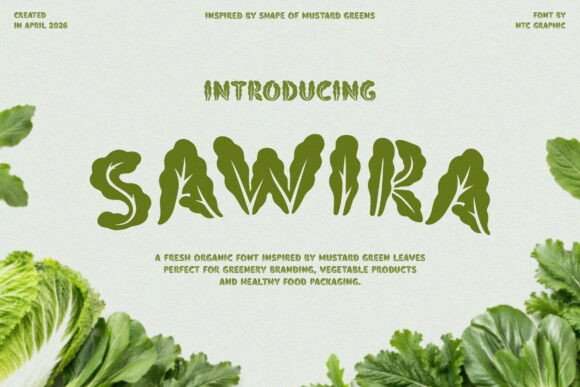
The moment Sawira loads in my design app, it doesn’t shout — it leans in. There’s a grounded warmth to its letterforms: generous curves, subtle contrast, and a gentle rhythm that feels hand-informed but precisely tuned. It’s not ornate, not retro, not minimalist — it’s present. Sawira reads as confident without arrogance, friendly without informality, and refined without stiffness. This isn’t a font that hides behind trends; it carries its own quiet authority. As a display font, it’s built for impact — but the kind that lingers, not blares.
Where Sawira Lives Best (and Where It Doesn’t Pretend To)
Sawira thrives where intention meets visibility. In logo design, it anchors brand marks with unmistakable character — especially for studios, artisanal brands, boutique publishers, or wellness-focused businesses. Its uppercase forms hold weight and distinction; lowercase has just enough personality to feel intentional, not whimsical. On packaging design, Sawira shines on primary labels, front-of-box hero lines, and limited-edition product names — think ceramic mugs, small-batch teas, or handmade soap wraps. It adds premium texture without demanding attention away from the product itself.
For social media graphics and digital ads, Sawira performs strongly at headline scale (48px and up) on light or muted backgrounds. It pairs beautifully with clean sans serif fonts for body copy — no fighting for dominance, just clear visual hierarchy. In editorial design, I’ve used it for section headers in print zines and blog features — always sparingly, always with breathing room. It also works surprisingly well on merchandise: embroidered patches, screen-printed tote bags, and vinyl decals gain tactile credibility when Sawira’s structure is translated into physical form.
But let’s be direct: Sawira is not for body text. Not for dense paragraphs. Not for mobile navigation menus. Not for data tables. It’s a display font — and it knows its role. Trying to force it into supporting roles dilutes its strength and compromises readability. Use it for short phrases, brand marks, quotes, or decorative accents — never as filler.
What Happens When You Actually Use It
In real client work, Sawira consistently lifts perceived professionalism. It signals care — not just in the final output, but in the decision-making behind it. When paired with a neutral sans serif (like Inter or Poppins), it creates immediate contrast and clarity. Beside a warm serif (think Merriweather or Cormorant Garamond), it adds modern energy without clashing. Against a delicate script font or expressive handwritten font, Sawira grounds the composition — it’s the steady hand holding space for more fluid elements.
Readability stays strong at 36–60px in digital contexts, but drops off quickly below 24px. I test every Sawira headline in black on white *and* white on charcoal — its open counters and balanced spacing hold up well, but tight tracking can blur letter distinction. For printable design like invitations or posters, I always export PDFs and view them at 100% zoom on screen *and* hold printed proofs at arm’s length. Sawira’s rhythm becomes more apparent in motion — how the eye moves across “Sawira” versus “Sawira & Co.” versus “Est. 2024” — and that’s where its true utility reveals itself.
Designer Notes You’ll Actually Use
- Always test in black and white first. Sawira’s charm isn’t dependent on color — if it doesn’t sing in grayscale, reconsider the context.
- Check small-size readability early. At 18px on a website hero banner, it may soften too much. If your use case demands legibility at smaller sizes, pair it with a robust sans serif for subheads instead of shrinking Sawira.
- Mock it up — don’t just preview. Drop Sawira into a real Canva template, paste it onto a Cricut project mockup, or layer it over a product photo in Photoshop. Does it sit comfortably? Does it enhance or compete?
- Compare uppercase vs. lowercase usage. Uppercase Sawira delivers boldness and cohesion; lowercase offers approachability and nuance. Don’t default — choose deliberately.
- Review spacing — especially kerning pairs like “To”, “We”, and “Av”. Some versions include OpenType features for refined alternates; enable them if available.
- Test font pairing rigorously. Try Sawira beside one serif font, one sans serif font, one script font, one handwritten font, and one other display font. Notice where hierarchy feels natural — and where tension arises without purpose.
- Confirm commercial licensing before any client or business use. Sawira is a premium font — verify usage rights for web embedding, digital products, merchandise, and SaaS platforms. Never assume.
Mood, Trust, and the Quiet Power of Choice
Sawira doesn’t chase virality — it builds recognition through consistency. When used thoughtfully across a brand identity, it becomes part of the voice: warm but precise, human but polished. That consistency translates directly to audience trust. People don’t remember fonts — they remember how a brand *feels*, and Sawira contributes meaningfully to that feeling. In crowded spaces like social feeds or retail shelves, its distinct yet unforced presence helps cut through noise without screaming.
It also invites engagement. On a blog graphic, Sawira draws the eye just long enough to read the headline — then gracefully steps aside for the content. On a product label, it communicates craft and care before the customer even reads the description. And in web design, when used for H1s or hero text, it establishes tone faster than any tagline.
Final Thought: A Tool With Temperament
Sawira isn’t neutral. It has temperament — and that’s its greatest strength. As a designer, I reach for it when I want typography to carry weight, warmth, and intention. It’s not for every project. But when the brief calls for authenticity with polish, for distinction without distance, for modern typography that still feels hand-touched — Sawira earns its place. Just remember: respect its limits, test without shortcuts, and let it do what it does best — command attention, then recede with grace.