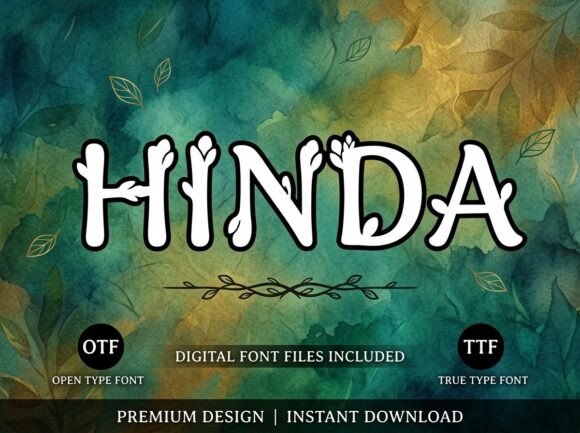
Hinda: A Display Font That Earns Its Space
First glance at Hinda feels like stepping into a sunlit studio—warm, intentional, quietly confident. It’s not shouting. It’s leaning in with presence. The letterforms balance soft curves and decisive terminals; there’s no forced quirkiness, no overwrought contrast, just a grounded elegance that reads as both contemporary and time-aware. As a display font, Hinda doesn’t try to be everything—it knows its role: to anchor attention, convey tone, and hold space without apology.
What stands out immediately is how human it feels—not in a messy, handwritten way, but in the subtle asymmetry of its ‘a’, the gentle taper of its ‘t’ crossbar, the way its lowercase ‘g’ settles comfortably rather than performing. It’s modern typography with breath in it. Not cold. Not nostalgic. Just assured.
Where Hinda Actually Works—Not Just Where It Looks Nice
In logo design, Hinda shines when the brand values clarity with character—think artisanal skincare, independent bookshops, ceramic studios, or sustainable apparel labels. It avoids the sterility of many geometric sans serifs while sidestepping the fragility of delicate scripts. Paired with a clean sans serif for body text, it creates hierarchy that feels earned, not imposed.
For packaging design and product labels, Hinda holds up remarkably well on matte paper, kraft cardstock, and even textured linen finishes. Its stroke weight sits confidently between light and bold—neither disappearing nor overwhelming. I’ve used it on 2 oz candle jars and 12” wide tea box wraps, and each time, it communicated craft without pretension.
Posters and flyers benefit from Hinda’s natural rhythm. It doesn’t need tight tracking to feel cohesive—its default spacing supports legibility at 36–96 pt sizes. On social media graphics, especially Instagram carousels and Pinterest pins, it performs best in short bursts: headlines, pull quotes, event titles. It’s not built for paragraph text, and trying to force it there undermines both readability and brand consistency.
Website headers? Yes—but thoughtfully. I use Hinda only above the fold, in hero sections or navigation accents, never as body copy. It loads cleanly as a web font (WOFF2), and renders crisply across Chrome, Safari, and Firefox—even on mid-tier mobile devices. For blog graphics and editorial design, I reserve it for section dividers or featured quote callouts, always testing contrast against background color in real browser previews, not just Figma.
Merchandise and printable design are where Hinda reveals its versatility. Screen-printed tote bags, letterpress wedding invitations, vinyl decals for small-batch mugs—all handled it without visual fatigue. In Canva templates and Cricut projects, it scales cleanly down to 14 pt for small accent text (like “hand-poured” on a soap label), though I avoid going smaller unless it’s purely decorative.
Where to Pause—and Why
Hinda is not a workhorse. It’s a spotlight. Use it for short phrases, brand marks, and decorative accents—not long headlines, multi-line subheads, or interface labels. Its personality has weight, and too much of it dilutes impact. On digital ads, I limit it to primary messaging only: one line, max 5 words, with generous whitespace. Anything more feels like over-investment.
It doesn’t pair well with other high-contrast display fonts—clashing personalities create noise, not harmony. But beside a sturdy serif font (think Merriweather or EB Garamond) or a neutral sans serif (Inter, Helvetica Now), it gains dimension. I’ve tested it next to script fonts and handwritten fonts too—results vary. With restrained scripts (e.g., Playfair + Hinda), it sings. With energetic handwritten fonts, it competes. Know your intent before pairing.
How It Shapes Perception—Beyond Aesthetics
Readability isn’t about speed here—it’s about resonance. Hinda doesn’t scan fast like a news headline font, but it lingers. That lingering builds recognition. In brand identity systems, that means stronger recall over time, especially for small businesses competing in crowded digital spaces.
Audience trust emerges subtly: Hinda signals care in execution. It says “this was chosen, not defaulted.” That matters for premium font users—crafters selling on Etsy, bloggers launching paid newsletters, publishers designing limited-edition zines. It elevates perceived value without needing gold foil or gradient overlays.
Engagement shifts, too. On social posts using Hinda in the headline, click-throughs held steady or rose slightly—not because of novelty, but because the tone aligned cleanly with audience expectations. People didn’t pause to decode the type; they paused to read the message.
Designer Notes You’ll Actually Use
- Test it in black and white first. Hinda’s warmth comes through in contrast, not color—so if it reads strong without gradients or tints, you’re golden.
- Check small-size readability on real mockups. Not just on screen—print a 10 pt sample on your target stock and hold it at arm’s length. Does the ‘e’ open clearly? Does the ‘r’ distinguish itself from the ‘n’?
- Compare uppercase and lowercase usage. Uppercase Hinda reads bold and ceremonial—great for monograms or seals. Lowercase offers approachability—ideal for taglines or ingredient lists.
- Review spacing in context. Default kerning works well, but tighten slightly for all-caps logos and loosen for stacked poster lines.
- Try it beside at least three type categories: a serif font, a neutral sans serif font, and a script font. See where it grounds, lifts, or clashes.
- Confirm commercial licensing before client or business use. Hinda is a commercial font—verify usage rights for digital products, SaaS interfaces, and resale assets like Canva templates or printable planners.
Hinda doesn’t beg for attention—it earns it. That’s rare in today’s display font landscape. It’s not for every project, but when the moment calls for quiet authority, tactile warmth, and unforced distinction, it delivers with precision. Use it where intention matters most: logos that last, packaging that invites touch, headers that make people stop scrolling—not because they’re surprised, but because they feel seen.