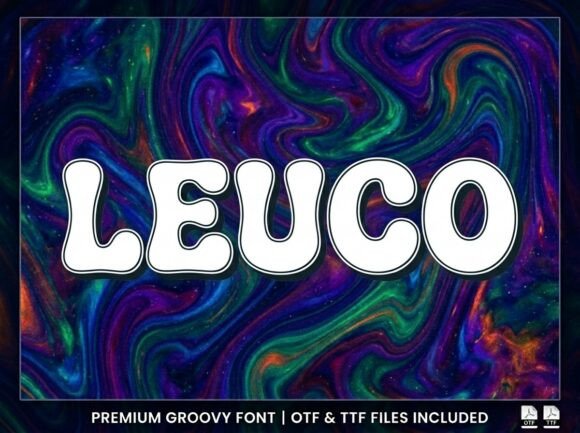
Leuco: A Display Font That Earns Its Space
Leuco arrives with quiet confidence—not shouting, but holding the room. As a display font, it doesn’t try to be everything; it knows exactly what it is: a refined, slightly architectural presence with subtle humanist warmth. The letterforms balance geometric discipline and organic flow—notice how the lowercase a and g lean into soft, open counters, while the uppercase L and E stand crisp and grounded. There’s no forced quirk, no overwrought contrast. Just clarity, intention, and a gentle sense of craft.
Where Leuco Naturally Lands in Real Projects
Leuco thrives where visual impact meets restraint. In logo design, it works best for brands that value sophistication without stiffness—think boutique skincare lines, independent publishers, ceramic studios, or modern architecture firms. It’s not for loud tech startups or playful children’s brands. It’s for the client who says, “I want to feel considered, not trendy.”
In packaging design, Leuco shines on premium product labels—especially matte-finish glass bottles, uncoated paper boxes, or linen-wrapped gift sets. Its even weight distribution and generous x-height mean it holds up beautifully at 18–36 pt on physical goods. On merchandise like tote bags or enamel pins, it scales cleanly without losing character—no jagged edges, no collapsed terminals.
For editorial design and blog graphics, Leuco excels as a headline typeface paired with a neutral serif or warm sans serif. It adds authority without coldness—ideal for long-form features, newsletter headers, or quote callouts in digital magazines. Social media graphics benefit from its strong silhouette: it reads instantly at thumbnail size on Instagram feeds or Pinterest pins, especially when used sparingly—as a single line of text over a muted background.
In web design, Leuco belongs in hero sections, not body copy. Use it for H1s on landing pages, announcement banners, or testimonial highlights. Avoid using it below 24 px on screen—it’s not built for paragraph reading. And skip it entirely for navigation menus or footer links. This isn’t a workhorse; it’s a spotlight.
Where Leuco Needs Thoughtful Handling
Leuco is strongest in short bursts: brand marks, taglines, chapter titles, poster headlines, invitation monograms, and social post captions. It’s not suited for long paragraphs, multi-line buttons, or dense infographics. Its rhythm slows down with length—what feels elegant in three words can feel stilted in twelve.
Uppercase settings deliver maximum presence and cohesion—great for logos and signage. Lowercase use is more nuanced: beautiful in editorial subheads or poetic quotes, but test spacing carefully. Kerning pairs like AV, Wa, and To need manual attention at larger sizes. Don’t assume default tracking will suffice.
Avoid pairing Leuco with other high-contrast display fonts. It doesn’t compete well—it collaborates. Try it beside a sturdy serif like Adobe Garamond for print layouts, or a friendly sans like Inter for digital interfaces. It also grounds script fonts beautifully: imagine Leuco as a bold header above a delicate handwritten byline. But don’t pair it with another decorative display font—that’s visual noise, not harmony.
What Leuco Does for Your Brand—and What It Doesn’t
Leuco strengthens brand consistency through tonal reliability. It doesn’t swing between moods. Once chosen, it becomes a recognizable anchor—especially in black-and-white applications like embossed business cards or foil-stamped packaging. That consistency builds trust: audiences begin to associate its clean structure with care, precision, and authenticity.
It elevates perceived value. Used thoughtfully, Leuco signals that a brand invests in detail—not just messaging, but materiality. That matters for small business owners selling handmade goods or digital sellers offering printable design assets. Customers notice when typography feels intentional, not imported from a free Google Fonts list.
But Leuco won’t fix weak hierarchy. If your layout lacks clear visual flow, slapping Leuco on top won’t help. It won’t make low-res photography look professional. And it won’t compensate for inconsistent color use or poor spacing. It amplifies what’s already working—it doesn’t replace foundational design thinking.
Practical Designer Notes You’ll Actually Use
- Test Leuco in black and white first—its strength lies in contrast and form, not color tricks.
- Check readability at real-world sizes: 16 pt on a product label, 20 pt on a Canva social template, 32 pt on a Cricut vinyl cut. Don’t rely on screen previews alone.
- Build mockups early—not just on white backgrounds. Try it over textured paper scans, soft gradients, or muted photography. See how its terminals interact with surrounding elements.
- Compare uppercase vs. lowercase in context. Some projects demand the gravitas of all-caps; others gain warmth from mixed case—but only if spacing and leading support it.
- Review letterfit and word spacing manually. Default values often tighten too much for display use. Add 20–40 units of tracking for headlines above 40 pt.
- Pair it deliberately: set a paragraph in a serif font (for editorial depth), a caption in a clean sans serif (for neutrality), and a pull quote in Leuco (for emphasis). That’s modern typography in action.
- Confirm commercial licensing before any client or business use. Leuco is a premium font—its license covers digital products, printable design, and brand identity work, but always verify scope, especially for SaaS platforms or embedded apps.
Final Judgment: Not Every Project Needs Leuco—But the Right One Will Feel Incomplete Without It
Leuco isn’t versatile. It’s selective. And that’s its power. When you’re designing for a brand that values stillness over speed, substance over flash, and craftsmanship over convenience—Leuco fits like a well-cut jacket. It performs reliably across packaging design, social media graphics, editorial design, and logo design—not because it’s flashy, but because it’s resolved.
It won’t go viral. It won’t trend on Dribbble. But it will hold space for your message, elevate your client’s credibility, and age gracefully in brand identity systems. That’s rare. That’s valuable.
If your next project asks for quiet authority, restrained elegance, or thoughtful distinction—Leuco isn’t just an option. It’s the right call.