Patugo: A Display Font That Grabs Attention—Without Screaming
Last Tuesday, I was finalizing a set of Instagram Story frames for a client’s summer content series—think bright backgrounds, bold overlays, and tight deadlines. The headline needed to pop instantly as users scrolled past. I tried three fonts: a clean sans serif (too quiet), a playful script (too fragile on small screens), and then—Patugo. Instant shift. Not because it’s loud, but because it’s present: chunky, confident, and full of motion—even when standing still.
What Patugo Actually Feels Like in Motion
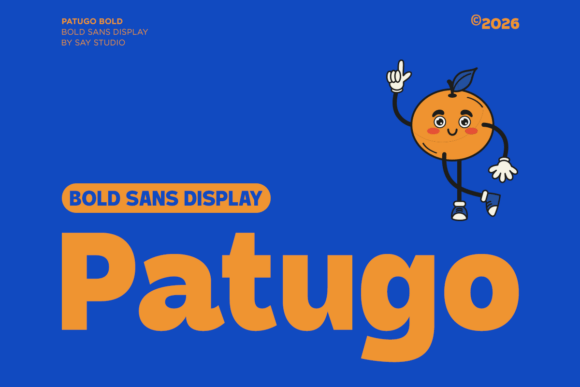
Patugo is a display font—not meant for paragraphs or fine print, but built for moments that need visual gravity. Its letterforms are generously proportioned, with smooth, almost bouncy curves and generous counters. There’s no sharp aggression here; instead, it balances playfulness with structural confidence. Think “friendly authority”: the kind of energy you’d want behind a new course launch banner, a limited-time offer sticker, or a YouTube thumbnail title that survives compression and thumbnail scaling.
It communicates warmth and approachability without sacrificing impact—a rare combo. In practice, that means Patugo doesn’t just sit on your design; it leans into the frame, holding space like a strong supporting character in a well-paced ad sequence.
Where It Shines (and Where It Steps Back)
I’ve used Patugo across six real campaign touchpoints this month—and each time, its role was clear:
- Instagram posts & Reels covers: Works best at 48–72pt on light or mid-tone backgrounds. On dark mode previews, I add a subtle white stroke (1px) to maintain legibility without losing its organic shape.
- YouTube thumbnails: At 320×180px previews, Patugo holds up surprisingly well—even compressed. Avoid thin weights or condensed variants; stick to the Regular or Bold. Letters stay distinct, even when scaled down.
- Digital ads (Meta & Google Display): Performs strongly in static banners under 300px wide. Tested with overlay text on lifestyle imagery—no halo effect needed, thanks to its generous spacing and open apertures.
- Email headers & landing page hero text: Great for short, action-oriented lines (“New Season Starts Now”, “Enroll Before July 15”). Not ideal for subheads longer than 6 words—it’s a headline font, not a workhorse.
- Pinterest pins & webinar banners: Stands out in fast-scrolling feeds thanks to consistent x-height and balanced weight distribution. No single letter dominates; the rhythm feels steady, not jarring.
Where it pulls back? Long-form email body copy, product description tables, legal disclaimers, or anything requiring dense, neutral readability. Also avoid using it for brand logotypes unless the brand voice fully aligns with its energetic, informal charm—it’s not built for corporate annual reports or formal invitations.
Pairing It Thoughtfully—Not Just Pretty
Patugo thrives when paired with something grounded. My go-to is a neutral, highly legible sans serif—like Inter, Poppins, or even system fonts like SF Pro or Segoe UI—for body copy, captions, and interface labels. The contrast creates hierarchy without tension: Patugo sets the tone, the companion font delivers the details.
I’ve also tested it successfully beside a restrained serif (e.g., EB Garamond at 14–16pt) for editorial-style quote graphics—especially for creative entrepreneurs or online course creators who want personality *and* polish. Avoid pairing with other high-contrast display fonts or busy scripts; Patugo doesn’t need competition—it needs context.
Practical Checks Before You Drop It Into Campaign Assets
Before locking in Patugo for client work or digital products, I always verify:
- Weight range: Does it include at least Regular and Bold? (Most versions do—critical for layered text treatments.)
- Ligatures & alternates: Not essential—but helpful for customizing “ff”, “fi”, or “fl” in logo-style applications or branded templates.
- File formats: Make sure you have both .woff2 (for web use) and .otf/.ttf (for design tools and print-ready assets).
- Licensing: Double-check commercial rights—especially if embedding in client websites, SaaS dashboards, or downloadable template packs. Some Display fonts restrict app or digital product usage unless upgraded.
- Language support: If your audience includes Spanish, French, or Portuguese speakers, confirm accented characters (ñ, é, ç) render cleanly—Patugo handles these well in most releases, but always preview.
One note on mobile previews: Patugo reads cleanly at 28–36pt on iOS and Android, but avoid setting it smaller than 24pt on image overlays—its curves soften slightly below that size, and optical clarity dips in fast-scrolling feeds.
A Font That Supports Strategy—Not Just Style
What makes Patugo more than just another fun typeface is how consistently it supports campaign intent. It doesn’t distract—it directs. When used intentionally—as a headline anchor, a campaign label, or a branded graphic motif—it reinforces message clarity before a single word is read.
In a feed where attention lasts less than two seconds, Patugo doesn’t shout. It arrives. With presence. With personality. And with enough craft behind it to hold up across formats, devices, and use cases—without needing constant tweaking or fallbacks.
If your next campaign needs a visual voice that’s energetic but never exhausting, friendly but never fuzzy, bold but never brittle—Patugo isn’t just an option. It’s a reliable, expressive tool in your typography toolkit.