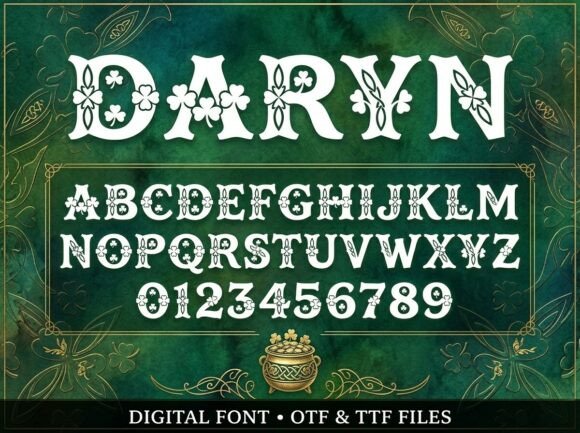
Daryn: A Bold Display Font That Commands Attention
There’s a quiet moment every designer knows—the one where you open a fresh brand board, the cursor blinks expectantly, and you scroll past your usual go-to fonts. You’re not looking for safe. You’re looking for spark. That’s when I dropped Daryn onto a café logo draft—just the name, centered, in all caps—and paused. Not because it was perfect right away, but because it had presence. Real presence. Not loud for loud’s sake, but with intention: sharp angles softened by subtle curves, confident spacing, and those little artistic flourishes that feel hand-tuned, not algorithmically generated.
What Daryn Actually Feels Like in Real Work
Daryn is a display font through and through—no pretending otherwise. It’s not built for paragraphs, footnotes, or legal disclaimers. It’s built for moments where you need eyes to stop scrolling, heads to tilt, and a brand to land with clarity and character. In my recent refresh for a small-batch skincare line, I tested Daryn across touchpoints: logo lockup, product label mockups, Instagram story headers, and even a simple business card. On the label—printed at 14pt on matte kraft stock—it held its shape beautifully. The contrast between thick strokes and delicate terminals gave texture without sacrificing legibility. On the website hero banner? At 48pt, it anchored the layout like a signature—confident, warm, quietly luxurious.
But here’s what stood out most: Daryn doesn’t shout *over* your brand—it gives it voice. Its personality is assertive but not aggressive, artistic but not chaotic. Think of it as the kind of typeface that would sit comfortably beside hand-poured candles, ceramic mugs, or limited-run zines—not corporate annual reports or banking apps.
Where It Shines (and Where It Doesn’t)
Logo design? Absolutely—especially for creative studios, boutiques, bakeries, or local restaurants leaning into authenticity and craft. I used it for a “handmade ceramics” studio identity, pairing the logo with a clean, neutral sans serif for body text. The contrast worked instantly: Daryn carried the soul; the sans carried the substance.
Packaging and product labels? Yes—if the label has breathing room. Daryn needs space to breathe. At under 10pt, details start to blur, especially in print. I tested it on a tiny jar sticker (8mm tall) and quickly swapped to a simpler alternate. For web use, it performs best above 32px in headings—never in navigation menus or paragraph leads. Social media graphics? Ideal for quote cards, launch announcements, or event posters where impact matters more than density.
It’s not suited for long-form editorial design, multi-page brochures, or any context requiring sustained reading. And while it’s expressive, it’s not whimsical or childish—so skip it for kids’ brands or ultra-casual food trucks unless you’re deliberately subverting expectations.
Pairing Daryn Without Overcomplicating It
My go-to pairing is still a sturdy, humanist sans serif—something like Poppins, Inter, or even a well-hinted version of Helvetica Neue. Why? Because Daryn brings so much visual weight and rhythm that it needs a calm, grounded counterpart. I tried pairing it with a high-contrast serif once (a Didot-style), and the result felt like two strong personalities arguing instead of harmonizing. A gentle serif—think Lora or Merriweather—can work for very specific moods (e.g., apothecary or literary branding), but keep line height generous and tracking slightly open.
Avoid stacking Daryn with other display fonts or scripts unless you have a clear hierarchy and ample white space. One accent font is enough. Let it be the soloist—not part of a choir.
Practical Notes Before You Commit
Daryn comes with a single weight (regular), no italics or bold variants—but it includes stylistic alternates and ligatures that add nuance without overdesigning. I found the alternate ‘g’ and connected ‘st’ ligature especially useful for tightening up logo lockups. No webfont files were included in my download, so for live sites, I converted and hosted it responsibly using @font-face—always checking the license first.
Which brings us to licensing: Daryn is a commercial font, and its license covers desktop use, web embedding (with proper hosting), and even merchandise—but only if explicitly permitted in your purchase agreement. I always double-check before adding it to client brand guidelines or packaging templates. Never assume “personal use” covers a Shopify store or Etsy shop—even if it’s just one product.
Before locking it into final deliverables, test Daryn in context: paste it into your actual logo vector, drop it onto a real packaging mockup (not just a PSD), and preview it on mobile. Does it hold up at 75% scale? Does the kerning look even in your exact wordmark? Does it feel like *that brand*, or just “a cool font”? Those are the questions that separate good typography from great branding.
Final Thought—Not a Tool, But a Tone Setter
Daryn isn’t about solving a technical problem. It’s about setting a tone fast—before a single word is read. It tells people, “This isn’t generic. This has care. This has point of view.” Used thoughtfully, it becomes part of the brand’s texture—not just decoration, but definition. And in a world full of interchangeable visuals, that kind of distinction isn’t just nice. It’s necessary.