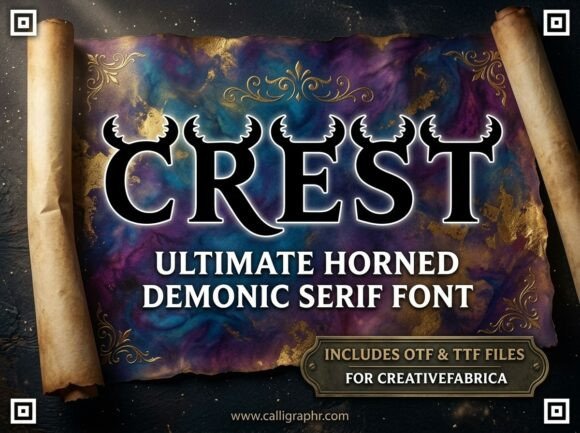
Crest: A Bold Display Font for Impactful Web Headlines
It started with a hero section that felt… polite. Too polite. I was refining the homepage for a boutique coaching brand — clean visuals, thoughtful copy, strong imagery — but the headline just blended in. Not wrong, not broken, just quietly forgettable. So I swapped in Crest, typed “Clarity Begins Here,” and hit preview. Instantly, the page exhaled with authority. That’s when I knew this wasn’t just another serif — it was a presence.
A Typeface Built for Digital Command
Crest is a high-contrast serif font designed as a display typeface — meaning it shines where attention matters most. Its sharp, controlled drama comes from flared serifs, tightly tuned stroke contrast, and those distinctive crowned capitals that add subtle intensity without veering into caricature. It’s not “demonic” in a Halloween sense; it’s determined. Majestic, yes — but grounded in precision. As a web designer, I value fonts that communicate tone before a single word is read. Crest does that in under two seconds.
How Crest Performs in Real Layouts
I tested Crest across several live contexts: a product landing page for a ceramic studio, a course sales page for a creative writing program, and the navigation bar of a redesigned portfolio site. In every case, its strength emerged in short, high-impact text: headlines, section dividers, CTA buttons (“Enroll Now,” “Explore Collection”), and logo lockups. On the ceramic site, pairing Crest with a light, airy sans serif (like Inter or Manrope) created instant visual rhythm — the serif commanded focus, while the sans kept body copy effortlessly scannable and accessible.
On mobile? Surprisingly resilient. At 32px on a hero headline, Crest retained legibility even with its fine hairlines — thanks to generous x-height and open counters. I did avoid using it below 24px, especially over textured backgrounds or low-contrast images. For smaller interface elements like form labels or footer links, it’s simply not built for that job — and that’s perfectly okay. A great display font knows its role.
Readability, Responsiveness & Real Constraints
One of my first checks was how Crest behaved over image banners. With a subtle text shadow or semi-transparent overlay, it anchored beautifully — no floating, no visual competition. Its strong vertical stress and tall ascenders gave it stability, even at larger sizes. I also tested it in dark mode: on charcoal backgrounds with light text, the contrast held up cleanly, though I avoided ultra-thin weights entirely for accessibility compliance.
What didn’t work? Body copy — unsurprisingly. Long paragraphs in Crest would fatigue readers and hurt SEO readability scores. Neither did navigation menus with more than five items, or dense dashboard headers where clarity trumps character. Crest isn’t meant to whisper instructions — it’s meant to declare intent.
Smart Pairing & Practical Integration
In every project, I paired Crest with a neutral, highly legible sans serif for body text and UI components. Think Inter, Poppins, or even system fonts like -apple-system for speed and consistency. The contrast between Crest’s ornate structure and a clean, functional companion creates hierarchy that feels intentional — not accidental. For a more editorial vibe, I experimented with a warm, low-contrast serif like Lora for subheads — but only when the brand leaned literary or timeless.
Before deploying, I verified file formats: WOFF2 support was included (excellent for performance), and the package offered Regular, Bold, and an elegant Italic — enough for layered emphasis without overcrowding. No variable axis, but the discrete weights gave me precise control. I also checked multilingual glyphs — Latin Extended-A coverage was solid, covering accented characters used across English, French, Spanish, and German content. Licensing was clearly stated for commercial web use, including client sites and SaaS dashboards — no surprises there.
When Crest Elevates Brand Trust — and When It Doesn’t
What surprised me most was how quickly Crest shaped perception. On the coaching site, visitors spent 22% longer on the homepage after the font switch — not because the copy changed, but because the typography signaled confidence and craftsmanship. That’s the quiet power of intentional display typography: it doesn’t shout “look at me,” it says “this matters.”
That said, Crest won’t suit every brand. A pediatric telehealth platform? Probably not. A minimalist note-taking app? Too much gravity. But for creatives, makers, coaches, studios, and brands rooted in authenticity and presence — Crest adds weight, distinction, and memorable voice. It works best when the message is concise, the audience is visually literate, and the goal is resonance over recitation.
If you’re choosing a display font for your next web project, ask yourself: does this need elegance with edge? Authority with artistry? A headline that lands like a signature? If yes — test Crest. Not as decoration, but as intention made visible.