Bravemont: A Display Font That Adds Soul to Digital Headlines
I was halfway through building a landing page for a ceramicist’s new online studio when I paused—cursor hovering over the font selector, hero section half-finished. The client described her work as “earthy but playful,” “crafted with intention, not perfection.” Her brand voice wasn’t sleek or minimal—it was warm, tactile, human. So I loaded Bravemont.
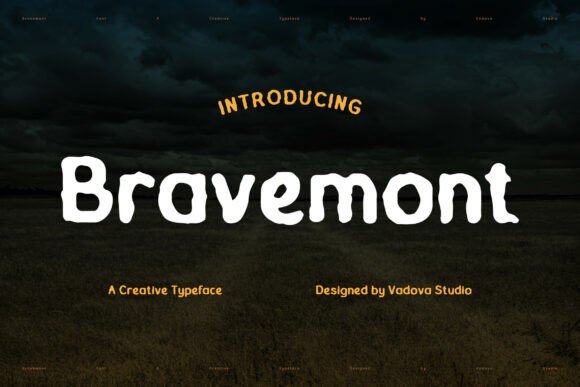
Right away, it clicked. Bravemont isn’t another polished geometric sans or delicate serif. It’s a display font built for presence: bold letterforms with subtle irregularities—slight asymmetry in the ‘S’, a hand-carved weight shift in the ‘M’, uneven baseline rhythms that feel intentional, not accidental. It carries a rugged-and-whimsical soul, exactly as its description promises—and that matters more than you’d think when your headline needs to land in under two seconds.
In practice, I used Bravemont for the hero headline (“Hand-Built Ceramics, Made With Fire & Feeling”) and the subheading (“Studio collections • Workshops • Custom commissions”). No body text—just those two lines, set large against a soft-focus photo of raw clay and glaze tests. On desktop, it felt grounded and expressive. On mobile? Still legible at 48px, especially with generous letter spacing and a subtle text shadow for contrast against the image overlay.
That’s where Bravemont shines: as a focused typographic accent. It’s not meant for paragraphs, navigation menus, or dense feature lists. But for hero titles, section dividers (“Why Work With Me”), CTA buttons (“Reserve Your Spot”), shop banners (“New Glaze Series — Launching Friday”), or even short logo lockups? Absolutely. Its personality adds instant character without demanding attention in a distracting way—unlike some script or ultra-decorative fonts that sacrifice clarity for charm.
Readability is thoughtful—not perfect, but purposeful. At smaller sizes (below 32px), the irregular strokes start to blur on lower-DPI screens, so I avoided using it in mobile navigation or footers. But for anything above 36px—even on older Android devices—it holds up well, especially with high-contrast backgrounds. I tested it over both light and dark image overlays, and found it most effective with a soft 2–3px drop shadow or a semi-transparent background bar behind the text. No heavy outlines needed; just enough contrast to let the texture breathe.
Pairing Bravemont was intuitive. I chose Inter for all body copy, form labels, and secondary text—a clean, highly readable sans serif with excellent web performance and open-source licensing. The contrast worked beautifully: Bravemont brought warmth and craft; Inter brought clarity and trust. For a coaching site or editorial blog, you could swap in a gentle serif like IBM Plex Serif or Charter for a more literary, grounded tone—but always keep body text neutral and highly legible. Bravemont is the spark; the supporting typeface is the steady flame.
I also checked what came in the package before deploying: multiple weights (Bold and ExtraBold), true italics (not slanted), basic Latin multilingual support (covers English, Spanish, French, German, Portuguese), and OpenType features like stylistic alternates. No variable font axis yet—but the included weights gave me flexibility for hierarchy without needing extra files. Webfont files were lightweight (WOFF2 only), and the license clearly permits commercial use across websites, client projects, digital templates, and brand kits—no surprises at handoff time.
What surprised me most was how quickly it shaped the rest of the design system. Once Bravemont was in place, the color palette softened (warm ochres, muted clays), spacing opened up (more breathing room around headlines), and even icon choices leaned handmade—line-drawn, slightly imperfect. It didn’t just sit *on* the page; it helped define the page’s rhythm and tone. That’s the quiet power of a strong display font: it doesn’t shout—it invites alignment.
For portfolio sites, course sales pages, boutique e-commerce banners, campaign microsites, or even podcast episode graphics, Bravemont works because it feels *authentic*, not decorative. It signals craftsmanship without cliché—no faux-vintage filters or forced distressing. Just honest, hand-informed structure. And in a digital landscape saturated with ultra-sleek, algorithm-optimized type, that honesty stands out.
One note on implementation: always test Bravemont with real content—not just “Lorem ipsum” or single words. Its charm lives in rhythm and variation, so try full phrases. Watch how the ‘g’, ‘a’, and ‘y’ sit together. See how line breaks flow across breakpoints. And if you’re using it over photography, preview in Safari and Firefox—not just Chrome—as rendering differences can affect perceived weight and spacing.
Bravemont won’t solve every typography challenge. It won’t replace your system font. But when you need a headline that feels human-made—not AI-generated, not templated, not generic—it delivers. It’s a reminder that digital design isn’t just about function and speed. Sometimes, it’s about letting texture show through. Letting imperfection speak with confidence. Letting your brand feel like it has hands.
If you're choosing a premium font for a creative project—whether it's a product landing page, a digital brand kit, or a small business website—Bravemont earns its place not as decoration, but as intention made visible.