Simple Polkadot: A Playful Display Font That Delivers Joy—Not Just Dots
There’s a moment every brand designer knows well: opening a fresh brand board, coffee in hand, staring at a blank logo mockup wondering, What voice does this project need? For a recent handmade ceramics studio refresh—think earthy glazes, soft textures, and joyful imperfection—I reached for Simple Polkadot. Not as a gimmick, but as a deliberate tonal anchor. And honestly? It surprised me—not with flashiness, but with how thoughtfully its charm holds up across real applications.
A Typeface With Personality, Not Just Pattern
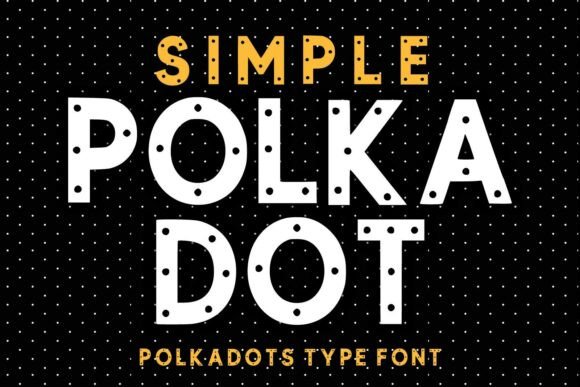
Simple Polkadot is exactly what the name suggests: a display font where each letterform contains subtle, evenly spaced polka dots—some inside counters (like the ‘o’ or ‘e’), others dotting stems or crossbars. But it’s not cartoonish. The underlying structure is clean, slightly rounded, with friendly proportions and open spacing. It reads as cheerful without tipping into cutesy overload. That balance matters—especially when you’re building a cohesive identity, not just slapping on a trend.
I tested it first on the studio’s logo lockup: “Clay & Co.” set in Simple Polkadot, paired with a warm, neutral sans serif for the tagline. At 48pt on screen and 36pt printed on a business card, the dots stayed crisp and legible. No blurring, no visual noise—even at smaller sizes than I’d normally risk with a decorative font. That’s rare. Most display fonts lose their magic below 32pt; Simple Polkadot stays readable down to ~24pt in high-res contexts, like website headers or Instagram story text overlays.
Where It Shines (and Where It Steps Back)
This isn’t a workhorse font—and it shouldn’t be. Simple Polkadot is a display font through and through. It thrives in short-form, high-impact roles: logo wordmarks, product labels (“Hand-thrown mug”), social media banners, packaging accents, and event posters. On ceramic jar labels, it gave instant warmth—pairing beautifully with matte kraft paper and minimalist line art. On a café’s seasonal menu board (yes, I tested it there too), it added levity without undermining clarity.
But let’s be practical: don’t use it for body copy, legal disclaimers, or multi-line website navigation. Its decorative nature slows reading speed past two words. And while the dots are charming at scale, they vanish—or worse, blur—below 16pt in print or on low-DPI screens. I tried it on a tiny receipt stamp. Nope. Not viable.
It also doesn’t come with weights or italics—just one upright, medium-weight style. That’s fine for its purpose: it’s not meant to carry hierarchy alone. Think of it as your accent voice—not the full chorus.
Smart Pairing Makes All the Difference
Simple Polkadot sings when paired intentionally. My go-to combo? A grounded, humanist sans serif like Poppins or Lato for supporting text—clean enough to let the dots breathe, warm enough to match the tone. For editorial layouts (like a small-run zine for the ceramics studio), I layered it with a gentle serif—Cormorant Garamond—for headings, letting Simple Polkadot handle subheads or pull quotes. The contrast worked because both fonts share softness, but not sameness.
Avoid pairing it with other highly decorative fonts—no double-script combos, no competing display faces. And skip tight, geometric sans serifs (think Helvetica Neue Bold); their rigidity clashes with Simple Polkadot’s organic bounce. When in doubt, test the pair at actual size on the final medium—mockups lie less than PDFs.
Licensing, Formats, and Real-World Readiness
The version I used included OTF and WOFF2 files—solid for both desktop design and web embedding. No variable axis, no stylistic sets, no swashes or alternates. Just one clean, well-hinted style. That simplicity is part of its strength: it does one thing well, without overcomplicating your workflow.
Crucially, it’s a commercial font—meaning you’ll need an appropriate license for client work. If you’re designing packaging, digital templates, or merch for a small business, verify the license covers production use (not just personal projects). Some marketplaces bundle desktop + web licenses; others separate them. Always check before sending files to print or uploading to Shopify.
Honest Guidance for Your Next Project
Simple Polkadot won’t fix weak branding—but it will amplify sincerity. It works best when the brand already has warmth, playfulness, or handmade authenticity baked in. For a corporate fintech rebrand? Skip it. For a children’s book illustrator launching a shop, a local bakery naming their “Sprinkle Loaf,” or a craft fair vendor designing booth signage? Absolutely consider it.
Before committing: drop it into your actual layout—not just a font sampler. Try it on a photo background, over a texture, beside your primary color palette. See how the dots interact with nearby elements. Does it feel like part of the system—or like a sticker slapped on top?
And remember: great typography isn’t about novelty. It’s about resonance. Simple Polkadot resonates when joy is part of the brief—not as decoration, but as intention.