Halibus: A Playful Display Font That Feels Like a Warm Handshake
I opened my brand board for a new local ceramics studio last Tuesday—blank artboard, fresh color palette, and that familiar mix of excitement and quiet dread. Would the typeface I’d sketched in my notebook actually hold up? I dropped in Halibus as a logo test, just two words: “Clay & Co.” Nothing fancy. Just uppercase, centered, at 48pt. And instantly—the whole mood shifted. It wasn’t just legible. It felt present. Friendly, grounded, quietly confident.
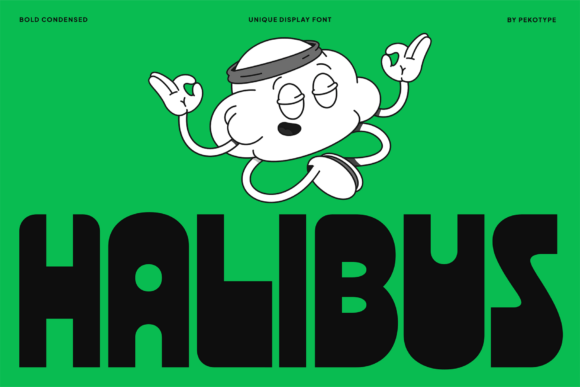
That’s the thing about Halibus: it’s a display font, yes—but not the kind that shouts just to be heard. Its soft, rounded shapes give it a tactile warmth, like hand-thrown pottery or a well-worn wooden sign. The letters are chunky without being heavy, playful without tipping into cartoonish. There’s a subtle bounce in the curves, a gentle weight distribution that makes even short phrases feel alive. I’ve seen display fonts go too far—either too rigid or too whimsical—and lose their usefulness across real brand materials. Halibus lands right in the middle: bold enough for impact, friendly enough to invite.
We used it first on the studio’s shop sign mockup. Printed on matte white enamel with a warm charcoal background, Halibus held its shape beautifully at 36 inches wide. No blurring, no awkward spacing gaps—even at large scale, the letterforms stayed cohesive. The rounded terminals softened the edges just enough to echo the organic forms of the ceramics themselves. On business cards, it worked surprisingly well at 14pt for the studio name—still readable, still expressive. Not something you’d use for body text, of course, but perfect for anchoring identity in small, high-impact moments.
For packaging, we paired Halibus with a clean, airy sans serif (a light weight of Inter, to be exact). The contrast was immediate and effective: Halibus carried the brand voice—warm, handmade, approachable—while the sans handled ingredient lists, care instructions, and fine print with calm authority. That pairing isn’t accidental. Halibus thrives when balanced against something neutral. Try it with a sturdy serif like Merriweather for editorial pieces, or a delicate script for limited-edition product labels—it adds contrast without competing. Just avoid stacking it with other rounded, bubbly display fonts; it loses its distinctness.
On social media graphics, Halibus shined brightest in vertical Instagram posts and story banners. Its generous x-height and open counters kept text crisp even when scaled down for mobile previews. We tested it over textured backgrounds—linen scans, clay slip washes—and it didn’t disappear. The weight holds up. That said, I’d skip using it for long captions or multi-line quotes. It’s designed for brevity: headlines, logos, signage, poster titles, product names. Think “Open Daily,” “Handmade in Portland,” or “New Glaze Drop”—not paragraphs.
One practical note: before locking it into the full brand system, I exported all available weights and alternates. Halibus includes a full set of stylistic alternates—slightly more exaggerated curves, optional connected glyphs, and a few clever ligatures (like the “ff” and “tt” combos) that add subtle rhythm without feeling gimmicky. We ended up using one alternate “a” in the logo lockup for extra character. Also worth checking: it supports Latin-based languages and comes in OTF and WOFF2 formats—so it’s ready for both print and web use, including CMS-driven sites and Shopify product pages.
Licensing was straightforward—standard commercial font license, covering digital ads, printed collateral, merchandise, and client deliverables. No surprises there. But what stood out was how consistently it performed across mediums. On a matte sticker label? Crisp. On a woven fabric tag? Still charming. In a website hero section with subtle parallax scroll? Absolutely magnetic. It doesn’t try to do everything—and that’s why it does so much well.
That said, I wouldn’t reach for Halibus if your project needs austerity, luxury minimalism, or technical precision. It’s not a corporate sans. It’s not a serif for academic publishing. It’s for brands that want to say, “We make things with care—and we don’t take ourselves too seriously.” Think neighborhood bakeries, indie bookshops, natural skincare lines, craft distilleries, or design studios that lead with humanity over hierarchy.
We tested it alongside three other display fonts—two geometric, one ultra-thin script. None landed quite right. One felt cold. One felt fragile. Halibus just… fit. Like finding the right apron for a workshop: functional, comfortable, and quietly expressive. It doesn’t overshadow the work—it elevates it by making the message feel human first.
If you’re evaluating Halibus for your own project, here’s what I’d suggest: start small. Drop it into one real context—your logo draft, your homepage banner, your product label mockup—and sit with it for a day. Does it feel *true* to the voice you’re building? Does it hold up at different sizes? Does it pair naturally with your secondary typeface? Don’t chase trends. Chase resonance. Because Halibus isn’t about being trendy—it’s about being warmly, unmistakably, reliably *there*.
It’s the kind of display font that reminds you why typography matters—not as decoration, but as tone, texture, and trust, all in one line of type.