Dessert Better: A Hand-Drawn Display Font for Editorial Charm
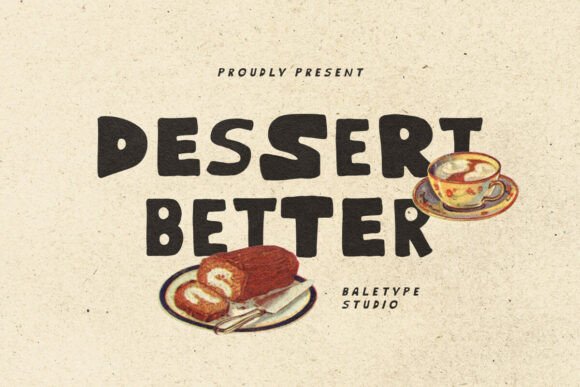
As someone who designs blog headers, magazine covers, ebook titles, and printable guides week after week, I’ve learned that the right display font does more than look pretty—it sets tone, signals intention, and quietly invites readers deeper. Dessert Better is one of those rare fonts that feels both intentional and effortless: a hand-drawn display typeface with bold presence, natural rhythm, and thoughtful variation between uppercase and lowercase forms.
What makes Dessert Better editorially compelling isn’t just its warmth—it’s how it behaves on the page. Each letter carries subtle irregularity: soft curves, uneven stroke weights, gentle tapering—details that echo human handwriting without sacrificing clarity. Unlike tightly scripted fonts that blur at small sizes or overly geometric displays that feel cold, Dessert Better lands with personality but stays legible across contexts—from a 48pt newsletter headline to a 24pt chapter opener in a PDF ebook.
Its strength lies in flexibility. The design intentionally includes distinct uppercase and lowercase shapes—not as strict alternates, but as expressive options you can mix within a single word. Try “Summer” with a tall, rounded uppercase S, then a relaxed, open lowercase u and m. That kind of controlled unpredictability adds visual interest without compromising cohesion. It’s ideal for moments where you want typography to feel curated, not automated.
In editorial design, Dessert Better shines most confidently above the fold: blog post headers, cover text for digital magazines, title pages for recipe ebooks, and quote graphics in lifestyle newsletters. Its bold weight anchors attention; its organic shape softens formality—making it especially effective for wellness blogs, wedding planning guides, creative coaching workbooks, and seasonal printables like holiday planners or summer challenge sheets.
Consider a digital magazine focused on mindful living. You might set the masthead in Dessert Better, then pair it with a warm serif font like Merriweather or EB Garamond for body copy—creating contrast that supports hierarchy while preserving readability. For captions, subheads, or navigation menus, a clean sans serif (think Inter or Lato) balances Dessert Better’s texture without competing. That pairing strategy—display font + readable serif/sans—holds up whether you’re exporting to PDF, embedding in an email template, or preparing a print-ready planner.
It’s also well-suited for social media graphics tied to your publication—quote cards, launch announcements, or workshop promo images—where strong typographic identity helps content stand out in fast-scrolling feeds. Because Dessert Better avoids tight spacing or excessive flourishes, it renders reliably across devices. No pixelation on mobile previews. No awkward line breaks in responsive newsletter layouts.
For creators building branded assets—lead magnets, worksheets, editable Canva templates, or Notion course kits—Dessert Better adds instant character without requiring design expertise. A simple worksheet header set in Dessert Better, paired with a neutral body font, conveys care and craft. Readers notice that difference, even if they can’t name why.
When evaluating display fonts for long-term use, I always check what’s included beyond the base style. Dessert Better offers multiple weights—enough to support clear visual hierarchy between main headlines and supporting subheads—plus stylistic alternates and ligatures that enhance flow in short phrases. While it’s not intended for extended body text, its character set covers Latin-based languages used across English, Spanish, French, and Portuguese publications—useful for bilingual newsletters or global-facing digital products.
Readability remains grounded in context. On screen, it performs best at 24pt and up for headings; in print, it holds clarity even at 18pt when set with generous leading. Avoid using it below 16pt in any medium—its charm lives in scale and gesture, not micro-detail. And because it’s a premium font, always verify licensing terms before embedding in client projects, paid newsletters, or downloadable templates. Most licenses for Dessert Better cover commercial use in ebooks, printables, web graphics, and digital publications—but not app UI or unlimited resale in editable design assets unless explicitly stated.
One practical note: if you’re working in Figma, Adobe Creative Cloud, or Google Docs (via third-party integrations), test how Dessert Better interacts with your default export settings. Some display fonts shift subtly in PDF rendering due to hinting or subpixel alignment—so always preview final outputs before sending to print or publishing a gated download.
Finally, consider how Dessert Better contributes to brand identity over time. Consistent use across covers, headers, and signature graphics builds recognition—not through repetition alone, but through emotional resonance. A recipe ebook titled in Dessert Better feels inviting, unhurried, and human-scaled. A coaching workbook with its chapter titles set in the same font signals approachability and intentionality. That’s the quiet power of thoughtful display typography: it doesn’t shout identity—it embodies it.
For publishers and independent creators who value both aesthetic integrity and functional clarity, Dessert Better isn’t just another font in the library. It’s a deliberate tool—one that supports storytelling, strengthens reader connection, and elevates everyday editorial work with understated confidence.