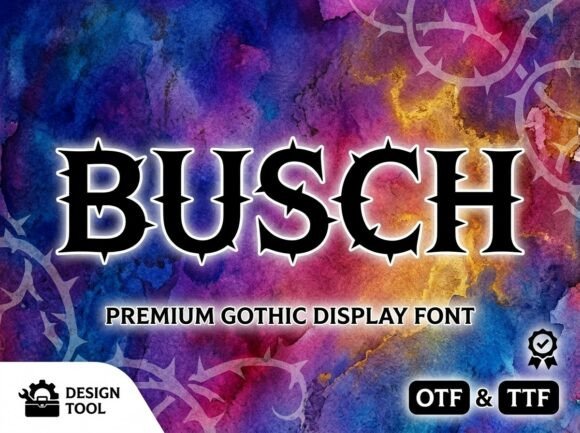
Busch: A Display Serif with Shadow and Substance
It was late afternoon, rain tapping softly against the window, when I opened a fresh layout for a digital wedding guide—something intimate, tactile, and quietly confident. The cover needed to feel like a pressed flower between book pages: delicate but intentional, elegant but grounded. I cycled through a dozen display fonts before landing on Busch. Not because it shouted loudest, but because it held space so deliberately—like a pause before a vow.
A Typeface That Breathes With Editorial Rhythm
Busch is a display serif—not meant for paragraphs, but for moments that ask to be lingered over. Its high-contrast letterforms are both sturdy and subtle: sharp serifs anchor each character, while the rhythmic stroke modulation gives it quiet motion—like ink settling just so on textured paper. There’s a shadowy stateliness here, yes, but no gothic drama or theatrical flourish. It’s restrained, not remote; dignified, not distant.
In practice, that rhythm translates beautifully across editorial touchpoints. I used Busch for chapter openers in a coaching workbook, where each title needed to land like a gentle invitation—not a command. It worked equally well as a pull quote in a lifestyle blog feature, its contrast drawing the eye without overwhelming the surrounding body text (a warm, readable serif I paired with it). Even in a printable planner, Busch lent quiet authority to weekly headers—never competing with checklists or notes, but framing them with intention.
Where Busch Finds Its Editorial Home
Busch thrives where tone matters more than volume. Think:
- Cover titles for recipe ebooks—especially those leaning into seasonal, slow-cooking, or heritage themes;
- Newsletter headers for independent creators who write with warmth and precision;
- Digital magazine section dividers, where a single word (“Reflection,” “Roots,” “Ritual”) sets the mood for what follows;
- Printable guides like wedding timelines or mindfulness worksheets—where visual calm supports emotional clarity;
- Pull quotes and epigraphs in long-form editorial features, adding gravitas without interrupting flow.
What makes Busch especially useful is how it carries weight without heaviness. On screen, it renders cleanly even at modest sizes (24–36pt), and in PDF exports, its crisp outlines hold up beautifully in both RGB and CMYK workflows. For print materials—think letterpress-style wedding stationery or chapbook covers—it gains a lovely tactile presence, especially when printed on uncoated stock.
What Busch Isn’t Designed To Do
Let’s be clear: Busch is not a workhorse font. It’s not built for body copy, captions under 12pt, dense infographics, or formal reports where neutrality is key. Its expressive contrast and distinctive terminals don’t scale down gracefully—so avoid using it for footnotes, navigation menus, or mobile interface labels. It also doesn’t replace a versatile sans serif for UI elements or a robust serif for extended reading. That’s not a limitation—it’s a design decision. Busch knows its role, and it performs it with quiet confidence.
Pairing With Purpose
Busch shines brightest when paired thoughtfully. In my wedding guide, I set all body text in a relaxed, slightly rounded serif—something with generous x-height and open counters—to balance Busch’s refined tension. For captions and sidebar notes, I chose a clean, neutral sans serif: no frills, no competition, just clarity. That pairing created a natural visual hierarchy: Busch said *this matters*, the serif said *read this next*, and the sans said *here’s a detail*. No shouting. Just structure.
When testing Busch in a digital magazine layout, I appreciated how easily it coexisted with variable fonts—its static, crafted nature offered welcome contrast to fluid, responsive type systems. And for social media graphics? A single line of Busch over a muted photo background felt instantly editorial—not trendy, but timeless.
Practical Notes Before You Use It
Before integrating Busch into client work, templates, or paid digital products, take a moment to review what’s included. Does the family offer at least one bold weight—and perhaps an italic with true calligraphic flow? Are there stylistic alternates or discretionary ligatures you might want for custom headlines? Check multilingual support if your audience spans regions—some display fonts skimp on extended Latin or diacritic coverage. And always confirm licensing: a personal-use license won’t cover resaleable printables, ebook templates, or newsletter assets you distribute commercially. Busch is a premium font, and like any thoughtful design asset, it rewards due diligence.
What stays with me isn’t how Busch looks—but how it behaves. It doesn’t distract. It doesn’t demand. It simply deepens the atmosphere, steadies the rhythm, and reminds the reader: This moment was chosen. Whether you’re designing a quiet recipe ebook, a reflective coaching workbook, or a newsletter that feels like a letter from a friend—Busch offers the kind of typographic presence that doesn’t shout identity, but quietly embodies it.