Aconite: A Vintage Winter Display Font for Elegant Editorial Moments
It started with a quiet afternoon and a half-finished recipe ebook—pages of warm gingerbread notes, spiced pear preserves, and slow-simmered mulled wine. The content felt rich and intentional, but the cover lacked presence. I’d cycled through three clean sans serifs and two understated serifs, each technically sound but emotionally distant—like serving a hand-poured hot cocoa in a disposable cup. That’s when I opened Aconite.
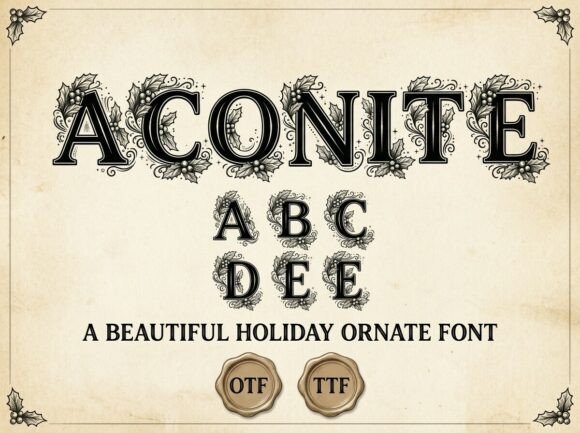
Aconite isn’t just another holiday font. It’s a display typeface that breathes like old paper and glows like candlelight on frosted glass. Every glyph carries the quiet confidence of a well-worn library book left open beside a crackling hearth: delicate etched strokes, subtle flourishes at terminals, balanced negative space, and a rhythm that slows the eye—not by demanding attention, but by inviting it. It’s not loud; it’s luminous.
I tested Aconite first as the title treatment on the ebook cover. Set large, centered, with generous letter-spacing and a soft charcoal gray on ivory linen-textured background—it transformed the entire mood. Suddenly, the project wasn’t just “a collection of winter recipes.” It became an invitation: Pause. Savor. Return to warmth. That’s the editorial power of a thoughtfully chosen display font: it frames meaning before a single word is read.
In practice, Aconite shines where intention meets elegance—blog headers that greet readers like familiar guests, chapter openers that mark transitions with grace, pull quotes lifted from interviews or personal essays, and printable planner covers that feel like heirlooms rather than downloads. I used it for section dividers in a digital wedding guide—paired with a gentle serif body text—and noticed how naturally it guided readers through emotional beats: “The First Look,” “Vows & Voices,” “Dancing Into Night.” Each heading carried weight without heaviness.
It’s worth noting what Aconite isn’t designed to do: serve as body copy. Its ornate character and lower x-height make extended reading tiring on screen or in print. But that’s not a limitation—it’s a clarity of purpose. As a display font, it excels in moments of emphasis: titles, logos, social media graphics, packaging design, newsletter headers, and editorial feature pages where tone matters as much as text. In a coaching workbook, I set Aconite for reflective prompts (“What does stillness ask of you this season?”) while keeping body instructions in a highly legible, open-countered sans serif—creating visual hierarchy that supports both mood and function.
Readability across formats held up beautifully. On retina screens, the fine details resolved cleanly. In PDF exports for printing, the outlines remained crisp—even at 14 pt for decorative subheads. For mobile layouts, I reserved Aconite strictly for hero text (never navigation or captions), then adjusted tracking slightly to preserve balance in narrower viewports. When exporting to EPUB, I confirmed the font included full OpenType support—including ligatures and stylistic alternates—which added nuance to repeated letter combinations like “ff” or “ct” in longer titles.
Font pairing feels intuitive with Aconite. I’ve found success anchoring it with a warm, humanist serif like Adobe Garamond or a relaxed, low-contrast sans like Inter or Lora for body copy. For captions, labels, or footnotes, a neutral, airy sans serif keeps focus where it belongs—on the Aconite-led moment. What makes the pairing work isn’t contrast alone, but shared values: warmth, restraint, and quiet confidence. No clashing energy—just complementary voices in the same editorial conversation.
Before committing to any project, I always check the technical details: included weights (Aconite offers one refined, fully hinted regular weight—perfect for its intended role), multilingual support (it covers Latin Extended-A, so works across English, French, Spanish, German, and more), file formats (OTF and WOFF2 included), and licensing clarity. Since I use fonts in client-facing digital products—ebooks, paid newsletters, printable planners—I confirmed the commercial license permits redistribution in static PDFs and web-based templates. No surprises, no last-minute swaps.
One unexpected joy came while designing a seasonal newsletter graphic. Instead of using Aconite for the headline only, I applied its alternate glyphs—subtle swash capitals and contextual ligatures—to a short tagline beneath: “Gather gently.” The effect was tender, unhurried, deeply human. That’s the kind of detail that elevates a good layout into something memorable—not flashy, but felt.
Aconite also deepens brand identity in subtle, cumulative ways. In a lifestyle blog redesign, using it consistently for post titles and archive banners created a seasonal cadence—readers began to associate its texture with moments of reflection, celebration, and pause. It didn’t shout “holiday!”—it whispered “intention.” And because it’s rooted in vintage winter aesthetics without leaning into cliché (no snowflakes, no bells, no forced cheer), it remains fresh beyond December.
If you’re selecting a premium font for a creator newsletter, editorial feature, course PDF, or printed guide, consider how much emotional labor your typography takes on. Aconite doesn’t compete with your words—it honors them. It asks readers to linger, not scroll. It turns functional text into tactile experience: ink on paper, light on snow, quiet on a winter morning.
Typography, at its best, is empathy made visible. Aconite reminds us that even in digital spaces, we can design for slowness, for resonance, for care. Not every project needs it—but when your content carries warmth, memory, or reverence, this display font becomes more than decoration. It becomes the first quiet note in a thoughtful composition.