Spring Honey: A Delightful Display Font for Handmade Creators
It was a quiet Tuesday morning—coffee steaming, Cricut warming up—and I opened my design file to finalize a set of lavender-scented candle labels. The scent notes were soft and floral, the kraft paper tags earthy and warm, but something felt off in the typography. The current font lacked that gentle lift, that sunlit sweetness I wanted to convey. That’s when I reached for Spring Honey.
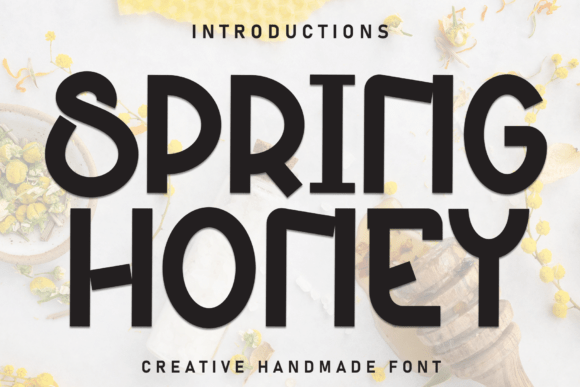
From the first keystroke, it clicked. Spring Honey isn’t just another script—it’s a display font with personality: light-hearted yet refined, playful without being childish, elegant without stiffness. Its letterforms flow like honey warmed by early sun—rounded terminals, subtle bounce in the ascenders, delicate contrast between thick and thin strokes. There’s a quiet confidence in its curves, a warmth that feels handmade, not algorithmic. It’s the kind of typeface that makes customers pause mid-scroll—not because it shouts, but because it invites.
I started small: testing “Lavender & Light” on a 2-inch round sticker. Spring Honey held up beautifully—even at that size, the letter spacing stayed open, the lowercase a and g retained their charm, and the subtle swashes added just enough flourish without compromising cut accuracy on my Silhouette Cameo. No jagged edges. No lost details. Just clean, joyful lettering that translated perfectly from screen to vinyl.
That success carried over into other projects. For a set of spring-themed greeting cards, I used Spring Honey for titles (“Hello, Sunshine,” “Bloom With Me”) paired with a crisp, neutral sans serif (like Montserrat or Inter) for body text. The contrast worked effortlessly—the display font sang as a headline while the supporting type kept things legible and grounded. Same rhythm applied to wedding invitation suites: Spring Honey for names and ceremony details, a simple serif for addresses and RSVP lines. It gave the whole suite cohesion—soft but intentional, romantic but never fussy.
As a printable creator, I also leaned into Spring Honey for digital wall art: minimalist botanical prints with phrases like “Grow Slowly” or “Tend Your Joy.” Because it’s a premium display font—not meant for long paragraphs—it shined where it belongs: in titles, quotes, and decorative accents. I avoided using it for full planner pages or journal prompts, but for cover pages, section dividers, or monthly headers? Absolutely. Its natural rhythm guided the eye without overwhelming the layout.
For physical merchandise—tote bags, ceramic mugs, wooden signs—I tested readability across materials. On uncoated kraft tags, Spring Honey’s medium weight printed cleanly. On matte-finish stickers, the rounded forms softened just right. Even laser-engraved wooden welcome signs held the character well—especially when I simplified the design to use only uppercase letters and omitted the most delicate swashes for deeper cuts. Pro tip: always preview your design at actual size before sending to print or cut. Spring Honey looks dreamy at 48pt—but shrink it to 8pt on a tiny gift tag, and those fine details blur. Stick to short phrases, names, and titles where its expressive nature can truly land.
What really made Spring Honey feel like a trusted studio tool was its versatility across formats. The package includes OTF and WOFF files, standard and discretionary ligatures, and stylistic alternates—including a charming lowercase Q with a looping tail and an & with a floral twist. I used those alternates selectively: the looping Q in a boutique’s “Quality Crafted” tagline, the floral ampersand in a wedding invitation monogram. These small touches added depth without extra design time.
Licensing mattered, too. As someone who sells both physical products and digital templates, I double-checked that Spring Honey includes commercial use rights—yes, it does, for unlimited physical items and digital downloads (including SVGs, PNGs, and editable Canva templates). No hidden restrictions. No surprise audits. Just clear, maker-friendly terms that let me focus on creating instead of compliance.
Pairing Spring Honey thoughtfully elevated everything. With farmhouse-style signage, I matched it to a sturdy slab serif for contrast—think “Honey & Thyme” in Spring Honey over “Est. 2022” in Rockwell. For social media graphics, I layered it over soft watercolor backgrounds and used its built-in kerning to tighten spacing around words like “Spring” and “Joy.” And for packaging? A single line in Spring Honey—“Hand-Poured With Care”—centered on a cream-colored box became the quiet signature of care customers noticed before even lifting the lid.
It’s not a font for every job. You wouldn’t set a product manual or ingredient list in Spring Honey—and you shouldn’t. But for moments that carry feeling—welcome boards, gift tags, seasonal shop banners, digital download covers, enamel pin slogans—it brings sincerity and lightness in equal measure. It reminds me why I love typography: not just as decoration, but as emotional shorthand. A well-chosen display font like Spring Honey doesn’t just say what something is—it says how it feels to hold it, receive it, live with it.
So if you’re choosing fonts for your next batch of candle labels, wedding stationery, printable planner kits, or boutique packaging—look for that balance of warmth and clarity. Choose a display font that supports your hand, not competes with it. Spring Honey does exactly that: it lifts your work without overshadowing your craft.