Quirky Memo: A Display Font That Feels Like a Handwritten Note From Your Brand
I was finalizing the Instagram carousel for a client’s new online course launch—three slides deep, 27 minutes before the scheduled post—and realized the headline on Slide 2 wasn’t landing. Not technically wrong: clean sans serif, bold weight, great contrast. But it felt like reading a grocery list instead of an invitation. So I swapped in Quirky Memo. Instantly, the tone shifted—not louder, but warmer. More intentional. Like the course itself had just leaned in and said, “Hey, I made this just for you.”
What Quirky Memo Actually Is (and Isn’t)
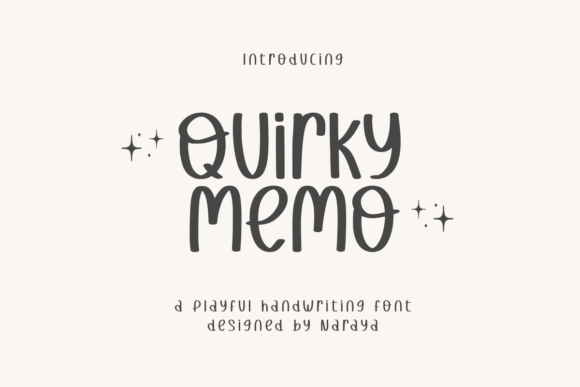
Quirky Memo is a display font—not a workhorse body typeface, but a deliberate accent. It’s designed with subtle irregularities: slightly uneven baseline alignment, gentle stroke variation, and soft, rounded terminals that avoid sharpness without slipping into cartoonishness. There’s no forced “handwritten” wobble or exaggerated slant; instead, it feels like someone wrote thoughtfully with a fine-tip marker on smooth paper—confident, unhurried, quietly personal.
Its personality sits at the intersection of approachable and intentional. Not playful enough for kids’ toys, not stiff enough for legal disclaimers. It communicates care—not perfection. That makes it especially effective when your campaign hinges on human connection: course launches, community announcements, small-batch product drops, or creator-led content series.
Where It Shines (and Where It Steps Back)
In real campaign use, Quirky Memo works best where attention is fleeting but emotional resonance matters most:
- Instagram posts & Reels covers: At 48–64px on mobile, its open letterforms and generous spacing hold up beautifully—even over busy background photos or gradient overlays.
- YouTube thumbnails: Paired with high-contrast color blocking (e.g., warm coral text on deep navy), it reads instantly at thumbnail scale without sacrificing charm.
- Email banners & landing page headers: Used as a single-line headline above a clean sans serif subhead, it adds distinct voice without slowing down scannability.
- Pinterest pins & digital ads: Its warmth cuts through algorithmic noise—not by shouting, but by standing out as *human* amid polished stock visuals.
It’s not built for long paragraphs, dense specs, or tiny UI labels. Don’t use it for pricing tables, footnotes, or navigation menus. And while it handles short phrases like “New Season Starts Now” or “You’re Invited” with ease, avoid stacking more than 6–8 words in a single line—especially over textured or low-contrast backgrounds.
Readability in the Real World
On mobile previews? Solid—if you keep line length tight and avoid light-on-light combos. I tested it over pale oat-colored gradients and found it held clarity better than many script fonts, thanks to its consistent x-height and uncluttered counters (the enclosed spaces inside letters like ‘a’, ‘e’, and ‘o’). On dark mode feeds? Works well with a crisp white or off-white weight—but skip ultra-thin variants unless you’re using it at large sizes with ample padding.
For fast-scrolling contexts (like Instagram feed or Pinterest grid), Quirky Memo benefits from strategic isolation: one word per graphic (“Yes.”, “Ready.”, “Here.”), or used only for the first two words of a headline—then switching to a neutral sans serif for the rest. This creates visual rhythm and gives the eye an anchor point without demanding decoding time.
Smart Pairings & Practical Checks
Quirky Memo thrives in contrast. My go-to pairing is a warm, humanist sans serif—think Inter, Poppins, or even a slightly softened version of Helvetica Now. The sans provides structure and neutrality; Quirky Memo brings character and pause. Avoid pairing it with other handwritten or script fonts—that dilutes its uniqueness and risks visual competition.
Before dropping it into client assets or templates, always check what’s included: Does the Quirky Memo package offer stylistic alternates (like a slightly bolder ‘g’ or simplified ‘&’)? Are there true italics—or just slanted versions? What file formats are supported (.woff2 for web, .otf for design apps)? And crucially—is the commercial license cleared for digital ads, client deliverables, and resale of branded templates? I once assumed a “personal use only” license covered a webinar banner—only to rework it mid-campaign after spotting the fine print.
Multilingual support is another quiet consideration. If your audience spans English, Spanish, and French, verify that accented characters (ñ, é, ü) render cleanly—not just in design software, but in email clients and ad platforms where fallback fonts can derail tone.
A Font That Supports, Not Overpowers, Your Message
Quirky Memo doesn’t solve strategy—it supports it. When your goal is to soften a hard sell, add sincerity to a limited-time offer, or make educational content feel less like homework and more like a conversation, it becomes a quiet collaborator. I’ve used it for a seasonal shop promo (“Winter Warm-Up Starts Friday”), a YouTube series title (“The Unhurried Edit”), and a set of quote graphics for a mindfulness newsletter—all with the same result: people paused longer, lingered on the text, and commented things like “This feels so *me*.”
That’s the mark of a strong display font: it doesn’t draw attention to itself, but to the feeling behind the words. Quirky Memo isn’t about being quirky for quirkiness’ sake. It’s about choosing warmth, clarity, and intention—every time you set type.